

7 Custom T-Shirts UK Options for Work and Events
Last Updated: November 10, 2026
Quick Summary
Custom t-shirts in the UK are best chosen by fabric weight and print method rather than price. Dprintclothing's range runs from £13.19 to £14.29, with weights from 150gsm for events up to 185gsm for trade use. Supply a high-resolution artwork file, order a single sample first, and size the run carefully.
- Heavier fabrics of 180gsm or more hold their shape and suit daily work wear.
- The range's price spread across all five shirts is £1.10, so weight should decide the pick.
- Supply a high-resolution artwork file at final print size to avoid a blurry logo.
- Order a single sample and wash it three times before placing a full bulk run.
- Ask for chest measurements in centimetres to build a size run that actually fits.
Table of Contents
- How to Choose Custom T-Shirts That Last
- Five Custom T-Shirts Compared Side by Side
- Custom T-Shirt Design Without a Designer
- Personalised Work T-Shirts for Trade Teams
- Embroidered Work T-Shirts: When Stitching Beats Printing
- Bulk Custom T-Shirts: Pricing, Sizes and Lead Times
- Order a Single Sample Before You Commit to a Run
- Frequently Asked Questions
How to Choose Custom T-Shirts That Last
Choosing custom t-shirts in the UK comes down to two things: fabric weight and how the print is applied. Get those right and a work shirt survives a full season of washes. Get them wrong and you are reordering by spring.
This guide from Dprintclothing covers seven options across our own range, from £13.19 to £14.29, plus the design, sizing and bulk-order decisions that sit behind them. Below, we show you exactly how to pick a shirt that still looks sharp after fifty washes.
The starting point is weight. A lightweight shirt feels great on day one and goes thin by month three. Heavier cotton holds its shape, hides print-through and takes a logo without distortion.
Fabric Weight and What It Means on Site
Fabric weight is measured in grams per square metre (gsm), and it is the single best predictor of how a shirt wears on site. Lighter weights suit promotional wear, while heavier weights suit work wear.
Here is how the weights in our range compare:
- 150gsm (Gildan Softstyle): light, soft, best for events and giveaways
- 165gsm (Fruit of the Loom Valueweight): the everyday middle ground
- 180gsm (Russell Classic T): heavyweight, holds shape, made for daily wear
- 185gsm (B&C #E190): the heaviest in the range, built for trade use
Weight and comfort are not opposites. Ring-spun is the term worth looking for on any spec sheet.
For a deeper breakdown of fabric weight, fit and care, see our guide to durable t-shirts for daily work.
Print Quality, Durability and Colour Accuracy
Print durability depends on the method and the artwork file, not on the shirt alone. A high-resolution file printed onto a smooth PurePrint or ring-spun surface gives a crisp edge. A low-resolution file gives a cracked, fuzzy logo, whatever the fabric.
Three things decide whether a printed design survives:
- File resolution: supply a high-resolution file at final print size
- Colour mode: check the colours on the proof before you approve it
- Wash care: follow the care instructions supplied with your garment
Watch out: uploading a logo screenshotted from a website is the most common cause of a blurry reprint. Ask your designer for the original file before you order.
Five Custom T-Shirts Compared Side by Side
Every shirt below can be printed to order with your logo, text or artwork. Here is the like-for-like comparison.
Shirt |
Fabric |
Weight |
Price |
Best For |
|---|---|---|---|---|
Russell Classic T |
100% ring-spun cotton |
180gsm |
£13.19 |
Daily trade wear |
Gildan Softstyle |
100% ring-spun cotton |
150gsm |
£13.63 |
Events and giveaways |
AWDis 150 |
PurePrint fabric |
Lightweight |
£13.74 |
Team uniforms |
Fruit of the Loom Valueweight |
100% cotton |
165gsm |
£13.74 |
Everyday workwear |
B&C Men's #E190 |
Pre-shrunk ring-spun cotton |
185gsm |
£14.29 |
Client-facing uniforms |
Price
The spread is £1.10 across the whole range, which is the point. Fabric weight, not price, should decide your pick. Browse the full custom Printer Prime T-shirt collection to see colourways and panel options.
Custom T-Shirt Design Without a Designer
You do not need design software to create a custom t-shirt design. Our online designer tool lets you upload artwork and add text to your design.
The workflow is straightforward:
- Pick your shirt, colour and size
- Upload a logo or artwork file
- Add custom text
- Check your design
- Order
A common mistake is placing a large chest print too high, so it collides with a collar or a jacket zip. Keep the top of the design roughly a hand's width below the collar seam.
Personalised Work T-Shirts for Trade Teams
Personalised work t-shirts solve a specific problem: a team that looks consistent on site without paying for full uniform. A printed logo on a heavyweight shirt reads as professional to a customer at the door, and it costs a fraction of a bespoke workwear programme.
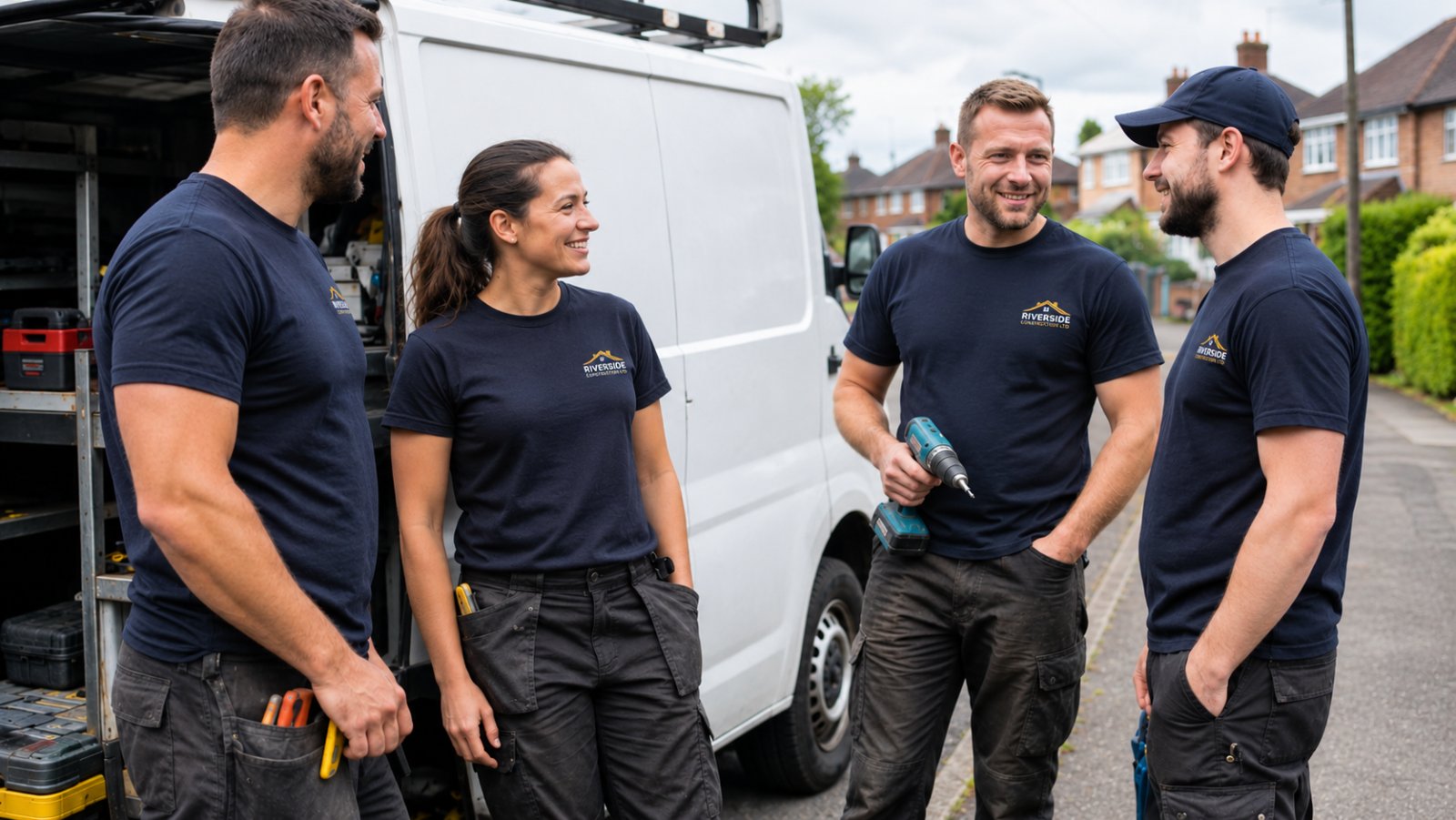
Tradespeople in matching branded t-shirts chatting by a van before a job
For trade use, we would pick the Russell Classic T or the B&C #E190. Both sit at 180gsm or above, both are ring-spun, and both hold a chest logo through repeated washing. Order the personalised work t-shirts range for your crew and size the order to include two shirts per person, so nobody is caught out on wash day.
Embroidered Work T-Shirts: When Stitching Beats Printing
Embroidery wins when the logo needs to survive years of industrial washing and still look premium. A stitched logo sits proud of the fabric, does not crack, and reads as higher-end on a client-facing uniform.
Printing wins on cost, colour range and fine detail. A multi-colour gradient or a photographic image cannot be stitched economically.
The rule we use: if the logo is a simple shape in two or three colours and the shirt is worn daily, embroider it. If the design is detailed, photographic or changes per event, print it. We run both services in-house, so you can split an order, embroidered jackets for supervisors and printed t-shirts for the wider team. For a full comparison of durability, cost and finish, read whether embroidery is better than printing.
Bulk Custom T-Shirts: Pricing, Sizes and Lead Times
Bulk custom t-shirts get cheaper per item as volume rises, and the biggest hidden cost in a bulk order is a sizing mistake. Order one size run too small and you are paying for shirts nobody wears. Order too few spares and you are paying a second setup and delivery charge for a handful of replacements.
How Volume Changes the Per-Shirt Price
Pricing on a bulk run is not a single discount, it is the sum of four moving parts: the garment, the print, any setup, and delivery. The garment price barely moves with volume. The print price per unit falls because the press run is amortised over more shirts. Setup is a one-off. Delivery is weight-based and rises with the order.
A common pattern across UK printers is a tiered structure roughly like this:
- 1-9 shirts: full per-unit print price, setup charged in full
- 10-24 shirts: modest per-unit reduction, setup absorbed
- 25-49 shirts: the first meaningful price break, often 15-25% off the single-unit print rate
- 50-99 shirts: a second break, with colour-count limits relaxed
- 100+ shirts: the best per-unit rate, usually quoted individually
What most guides miss is that the tier boundaries matter more than the headline discount. If you need 23 shirts, ask whether 25 is cheaper per unit once setup is absorbed, it often is, and the two extra shirts become free spares.
Building a Size Run That Fits
For a mixed team, a workable starting curve for every ten shirts is roughly: one XXS, one XS, two S, three M, two L, one XL, then add 2XL and above only for the people who actually ask. Trade and club orders skew larger than office orders, so shift one shirt from S to L if the team is on site all day.
Watch out: collecting sizes by asking people what they normally wear is the most reliable way to get a run that does not fit. Ask for a chest measurement in centimetres, or send one sample shirt round the team before you commit.
Lead Times and Deadlines
If you need shirts for a specific date, tell us the date at the point of order rather than after. Watch out: leaving a bulk order to the week before an event is the most reliable way to pay for express delivery you did not need.
Estimating the Total Landed Cost
Before you compare quotes, add up garment, print, setup, delivery and VAT so you are comparing like for like. A quote that looks cheaper per shirt can lose once delivery and setup are added, and a quote that looks dearer can win once a volume break kicks in. Ask every supplier for the same order size and the same print placement, then compare the totals, not the headline per-shirt figure.
Order a Single Sample Before You Commit to a Run
A single-item order is a sensible way to check a design before a larger run. Order one shirt, wash it three times, check the print and the fit, then place the full run.
This matters most for colour accuracy. Screen colours and fabric colours never match exactly, and a navy logo on a navy shirt can disappear entirely. One sample costs you a shirt. A wrong bulk order costs you fifty.
If you are ordering a single personalised gift rather than team kit, the process is identical: upload, preview, order. Our guide to printing a single custom t-shirt walks through artwork preparation with no minimum quantity.
Getting branded workwear right is mostly a discipline problem, not a budget one. Pick the fabric weight for the job, supply proper artwork, sample before you scale, and the shirts will outlast the contract.
Dprintclothing has provided custom apparel since 2015, working with Fruit of the Loom, Russell and Gildan, with bulk discounts available and fast delivery. Get started with Dprintclothing and kit your team out in shirts that still look right at the end of the season.
Frequently Asked Questions
How do I choose custom T-shirts for work?
Start with the job the shirt has to do. Client-facing uniforms need a heavier fabric that holds its shape through repeated washing, so a 180gsm to 185gsm ring-spun cotton is a safer bet than a light 150gsm tee. Then match the decoration to the logo: embroidery suits small chest badges and withstands industrial washing, while printed designs handle larger artwork and full-colour detail. Finally, check the size range covers everyone on the team before you order, and buy one sample to test the fit and finish.
What should I look for in a quality custom T-shirt?
Fabric weight and fibre content decide most of it. Ring-spun cotton feels smoother and pills less than standard cotton, and weights from 165gsm upward resist the thinning that shows logos through the cloth. Check that the print sits flat with no cracking at the edges, and confirm the colours match your brand guidelines rather than looking washed out. Pre-shrunk fabric matters for uniform runs, because a shirt that shrinks a size after the first wash throws off your sizing for the whole team.
Can I order custom T-shirts in different sizes and colours?
Yes. Each shirt in this range lets you pick from the available colour and size options, so a mixed order for a team is straightforward. Ordering one design across several sizes keeps your unit price consistent, and it avoids the mismatch that comes from splitting a run between two different garments. If your team spans a wide size range, gather measurements first and map them to the supplier's size chart rather than assuming everyone takes their usual high-street size.
How do I prepare a logo for custom T-shirt printing or embroidery?
Use the highest resolution artwork you have, so the edges stay sharp when printed. Simple, bold designs reproduce most reliably.
How long does it take to order custom T-shirts?
Ordering early gives you room to fix a colour or size problem before your event date.

