

How to Decide if Embroidery Is Better Than Printing
Table of Contents
- Embroidery vs Printing: The Core Differences
- Embroidered Logo vs Printed Logo: Which Suits Your Design?
- Durability and Lifespan: How Each Method Ages
- Cost and Pricing Factors: What Drives the Price
- Embroidery or Printing for Workwear: Matching Method to Garment
- Embroidery on T-Shirts: What to Know Before You Order
- Embroidery Durability and Care: Keeping Stitching Sharp
- Ordering Your Branded Garments with Confidence
- Frequently Asked Questions
Last Updated: October 26, 2026
Embroidery vs Printing: The Core Differences
Embroidery stitches thread directly into the fabric, while printing applies a design onto the surface. That single physical difference explains almost everything else: how each method feels, how long it lasts, and what it costs. At Dprintclothing, we run both processes daily, and the honest answer to is embroidery better than printing is that it depends on four things: garment, design, quantity and budget.
Here is what most guides get wrong. They frame this as a straight contest with one winner. It isn't. A structured work jacket and a lightweight summer tee pull in opposite directions, and the right method follows the garment, not the other way round.
Embroidery is a decoration method where a machine stitches coloured thread through the fabric to build a design. Printing applies ink or a printed transfer to the surface of the garment instead. Both are durable when done properly, but they age in different ways.
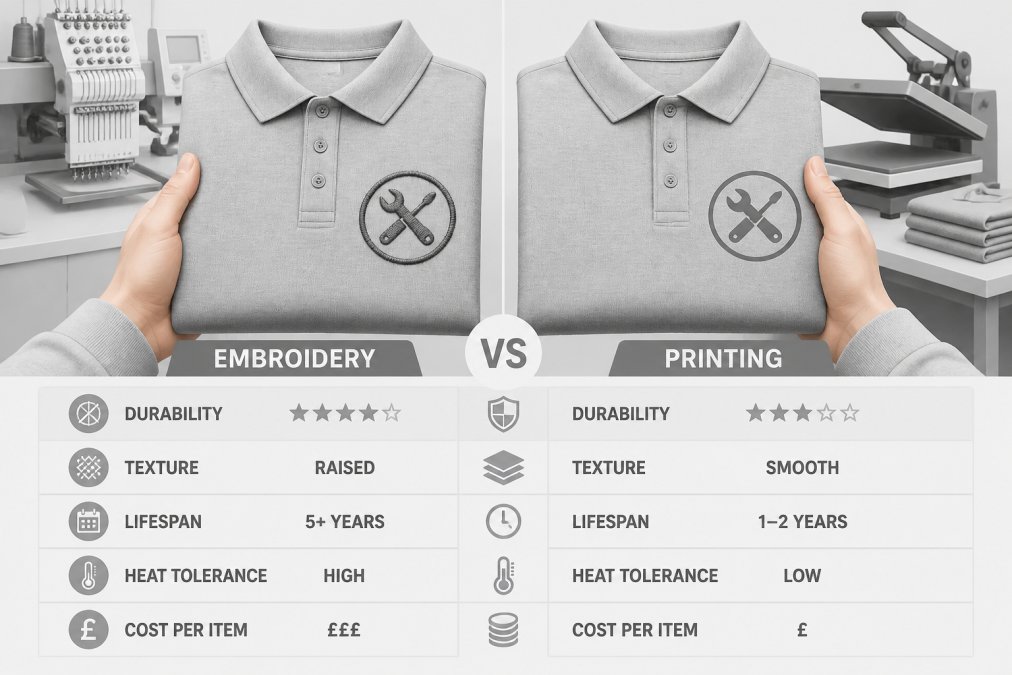
The practical split looks like this:
Factor |
Embroidery |
Printing |
|---|---|---|
How it sits |
Stitched into fabric |
Applied to surface |
Best for |
Logos, text, small designs |
Detailed artwork, gradients |
Texture |
Raised, premium feel |
Smooth, flat finish |
Setup |
Design digitising needed |
Artwork prepared for print |
Ages by |
Thread and stitch quality |
Ink adhesion and wash care |
The one drawback of embroidery is detail. Fine gradients and tiny text push any stitching machine to its limits.
Embroidered Logo vs Printed Logo: Which Suits Your Design?
An embroidered logo wins for simplicity and longevity; a printed logo wins for complexity and colour range. If your artwork is a clean wordmark, a crest or a bold icon, embroidery handles it beautifully and keeps its shape for years. If it relies on soft shading, photographic elements or dozens of colour blends, printing is the realistic choice.
Think in terms of stitch count. Every extra detail in an embroidered logo adds stitches, and dense designs on lightweight fabric can pucker or feel stiff. A common mistake is sending an intricate logo straight to embroidery without simplifying it first. A good supplier will tell you when a design needs adjusting.
Printed logos give you gradients, fine text and photographic detail, which is why they suit promotional graphics and event merchandise. The trade-off is a flatter look and more sensitivity to washing. For a side-by-side sense of what stitched branding looks like on a finished garment, browse our embroidered logo workwear range.
Durability and Lifespan: How Each Method Ages
Embroidery generally outlasts printing because thread is stitched through the fabric rather than sitting on top of it. A well-stitched logo survives repeated industrial washing, which is why it dominates uniforms and trade workwear. Printing holds up well too, but its lifespan depends heavily on ink quality, fabric type and how the garment is washed.
How each method fails
- Printing: the most common failure is cracking or peeling, usually triggered by tumble drying on high heat or washing at high temperatures. Ink adhesion also weakens on stretchy fabrics that flex repeatedly.
- Embroidery: the equivalent failure is thread breakage or bobbling from abrasion, typically on cuffs, hems and bag straps where friction is constant. Dense stitching on lightweight fabric can also distort the garment itself.
Neither method is permanent. Both fade or wear eventually, and the difference is in how gracefully they do it. Embroidery tends to dull slowly; print tends to fail suddenly, often in one wash cycle.
Fabric-specific risks
- Lightweight and stretchy fabrics: dense embroidery can pucker or feel stiff; printing flexes better but may crack if the ink is inflexible.
- Fleece and brushed fabrics: embroidery sinks into the pile and can lose definition; printing sits on the surface and may mat the nap.
- Waterproof and coated fabrics: stitching punctures the coating and can compromise water resistance; printing avoids perforation but needs the right ink system.
- Performance and synthetic fabrics: heat-sensitive materials can be damaged by high-temperature print processes; embroidery avoids heat but adds weight.
Care instructions that extend life
- Turn the garment inside out before washing
- Use a cool, gentle cycle
- Skip fabric softener, which can dull thread and degrade ink
- Air dry or tumble on low heat
- Iron around the design, never on top of it
Cost and Pricing Factors: What Drives the Price
Printing usually costs less per item at volume, while embroidery carries a higher unit cost because each logo is stitched individually. That gap narrows once you factor in replacement: a printed garment that fails after a season costs more over time than a stitched one that lasts three. The mistake most buyers make is comparing only the first quote.
Four factors move the price:
- Design complexity: more stitches or more ink colours mean more cost
- Order quantity: bulk orders lower the per-item rate for both methods
- Garment type: heavier fabrics and structured workwear cost more to decorate
- Setup: digitising an embroidery file is a one-off cost per design
Total cost of ownership, not unit price
The number that actually matters is cost per wear. Work it out like this:
- Take the quoted unit price for the decorated garment.
- Divide by the number of washes you expect before the decoration fails.
- Add the cost of replacing failed items within the garment's life.
A printed tee at a low unit price that cracks after 20 washes can cost more per wear than a stitched polo that survives 100+ industrial washes. Embroidery's higher upfront price is offset by fewer replacements, especially on uniforms that are worn daily and washed commercially.
How order size changes the maths
Setup costs are fixed per design, so they dominate small orders and shrink at volume. On a run of 10 garments, a one-off digitising charge can add a noticeable amount to each item; on a run of 200, the same charge is spread thin. Printing's setup is usually lighter, which is why it wins on short runs and one-off promotional pieces. Embroidery becomes more competitive as quantity rises and the garment is expected to last.
The hidden costs
- Replacement frequency: printed workwear on heavy-use uniforms may need replacing mid-contract; stitched logos usually outlast the garment.
- Rework: a design that puckers or distorts on a cheap lightweight garment is money wasted, always approve a stitched sample first.
- Care: high-heat tumble drying accelerates print failure, so drying costs and habits affect lifespan.
For a deeper breakdown of how these factors combine, read our guide on how much it costs to put a logo on a shirt. Run the cost-per-wear calculation before you decide, it often flips the choice on workwear.
Printed Epaulettes with Text or Logo →
Embroidery or Printing for Workwear: Matching Method to Garment
Embroidery is the stronger choice for workwear, and it isn't close. Structured garments like jackets, sweatshirts, polos and softshells have the weight and stability to carry stitching without distortion. They also face frequent washing and hard daily use, which is exactly where thread outperforms ink.
Lightweight, stretchy or highly textured fabrics are the exception. Thin tees and performance fabrics can ripple under dense stitching, so printing often suits them better. A hardwearing 300gsm blend, by contrast, gives embroidery a smooth, sturdy surface to work with, which is why we rate the embroidered RX301 Pro RTX sweatshirt as a natural fit for team branding.

Match the method to the garment's job. Client-facing uniforms need a finish that still looks sharp after a year of shifts. Promotional tees worn twice need colour and speed more than longevity.
Embroidery on T-Shirts: What to Know Before You Order
Embroidery works on T-shirts, but fabric weight decides the result. A mid-to-heavyweight cotton tee carries a chest logo cleanly; a thin, lightweight tee may pucker or drape awkwardly under dense stitching. Keep the design compact, place it on the chest or sleeve, and avoid large filled areas on stretchy fabric.
Ask for a stitched sample on the actual garment before committing to a bulk run. What looks fine as a digital mock-up can behave differently once thread meets cloth. If you want to see a finished example, our embroidered cotton T-shirt shows how a stitched logo sits on a standard tee.
A common mistake is ordering embroidery on the cheapest lightweight garment to save money. The savings vanish when the logo distorts.
Embroidery Durability and Care: Keeping Stitching Sharp
Embroidery durability comes down to two things: stitch quality and wash care. Wash garments inside out on a cool cycle, avoid high-heat tumble drying, and never iron directly over stitching. Follow those rules and a good embroidered logo holds its shape for years.
Care instructions matter more than most buyers expect:
- Turn the garment inside out before washing
- Use a cool, gentle cycle
- Skip fabric softener, which can dull thread
- Air dry or tumble on low heat
- Iron around the design, never on top of it
Watch out: bleach and harsh stain removers break down thread colour fast. Treat stains on embroidered garments gently and locally.
Ordering Your Branded Garments with Confidence
The right method is the one that fits your garment, design, quantity and budget, and a good supplier will tell you honestly when one beats the other. At Dprintclothing, we have offered both printing and embroidery since 2015, so we have no reason to push you toward either. Bulk discounts, fast delivery and a simple ordering process mean you can start with one garment or fifty.
Send us your artwork and we will tell you which method suits it. Explore our custom embroidery service to see how to get started.
Frequently Asked Questions
Is embroidery more expensive than printing?
Embroidery usually costs more per item than printing because it uses thread, a longer production run and a setup stage for digitising the design. The gap narrows on smaller logos and larger orders. For a like-for-like comparison, our embroidered epaulettes are £17.99 against £11.99 for the printed version, which shows the typical premium. Weigh that against lifespan: embroidery often outlasts the garment, so the cost per year of wear can end up lower.
Which lasts longer, embroidery or printing?
Embroidery generally lasts longer. Stitched thread sits within the fabric and resists fading, cracking and peeling through repeated washing. Printing sits on the surface and can wear faster on high-friction areas or after many hot washes. For workwear washed weekly, embroidery on a 300gsm sweatshirt like the RX301 holds its appearance far longer than a surface print. Care still matters: wash inside out and avoid direct ironing over the stitching.
Does embroidery work well on T-shirts?
It can, but the fabric weight decides the result. Lightweight, thin T-shirts may pucker or feel stiff under dense stitching, especially on large chest logos. A heavier cotton or poly-cotton blend gives the needle a stable surface. Keep embroidery on T-shirts to small chest logos or sleeve details, and choose printing for large back designs. If you are unsure, order one sample garment before committing to a full run.
Is embroidery or printing better for logos?
It depends on the logo. Embroidery suits simple, bold shapes, block text and small emblems, giving a textured, premium look that reads well on uniforms. Printing handles fine detail, gradients, small text and multi-colour artwork that stitching cannot reproduce cleanly. For a company logo with sharp geometry, embroidery is often the stronger choice for client-facing uniforms. For intricate artwork, printing wins. Check a proof of your logo in both methods before deciding.
Choosing between stitching and print shouldn't feel like a gamble. Bring us your design, garment and quantity, and we will recommend the method that holds up best for your team. Get started with Dprintclothing and order branded workwear that still looks professional after a year of daily wear.

