How to Judge Workwear Embroidery Quality for Small Business
Last Updated: November 15, 2026
Quick Summary
Judge workwear embroidery by stitch density, backing and thread, and approve a physical stitched sample on the actual garment before committing to a full run. For small teams, the best UK suppliers keep your stitch file, thread colour references and placement measurements on record so repeat orders match exactly.
- Hold the garment to a window: light should not show through the design.
- Polos, sweatshirts and softshell jackets carry embroidery best because their fabrics are stable.
- Very small teams can order embroidered workwear in single figures, not just in bulk.
- Ask whether the logo setup fee is charged once or per order.
- Confirm the dispatch date in writing and check whether it is a promise or an estimate.
Table of Contents
- What Separates Good Workwear Embroidery From the Rest
- How to Assess Workwear Embroidery Quality Before You Order
- Which Garments Suit Embroidered Company Logo Clothing
- Small Quantity Embroidered Workwear: What Very Small Teams Can Actually Order
- What to Expect From Workwear Embroidery Services
- The Real Cost of Embroidered Uniforms for a Small Team
- Ordering Your First Embroidered Workwear Set
- Frequently Asked Questions
What Separates Good Workwear Embroidery From the Rest
Good workwear embroidery is judged by three things you can check without any specialist equipment: stitch density, backing, and thread. At Dprintclothing, we have embroidered branded clothing since 2015, and those three details separate a logo that still looks sharp after fifty washes from one that puckers in a month.
Stitch density is how tightly the stitches pack together. Too sparse and the design looks thin and the garment shows through. Too dense and the fabric stiffens and can pucker.
Backing is the stabiliser behind the fabric that stops the embroidery pulling the garment out of shape. Thread quality decides how the colour holds up to washing and sunlight.
Stitch density, backing and thread: the three things you can check yourself
You do not need a lab. You need good light and five minutes.
- Hold the garment up to a window. Light should not show through the body of the design.
- Run a thumb across the back. A clean finish feels smooth, not lumpy or scratchy.
- Check the reverse side. Loose threads and a messy backing are a sign of a rushed job.
- Look at letter edges. Sharp, clean curves mean a well-digitised logo. Ragged edges mean the file was auto-converted.
The UK government guidance on textile labelling and fibre content is a useful reminder of how much information a garment label should carry. A supplier who cannot tell you the fabric weight and composition is hiding something.
How to Assess Workwear Embroidery Quality Before You Order
Always approve a physical sample before committing to a full run. A photograph of embroidery hides everything that matters: puckering, colour accuracy, and how the logo sits on the fabric.
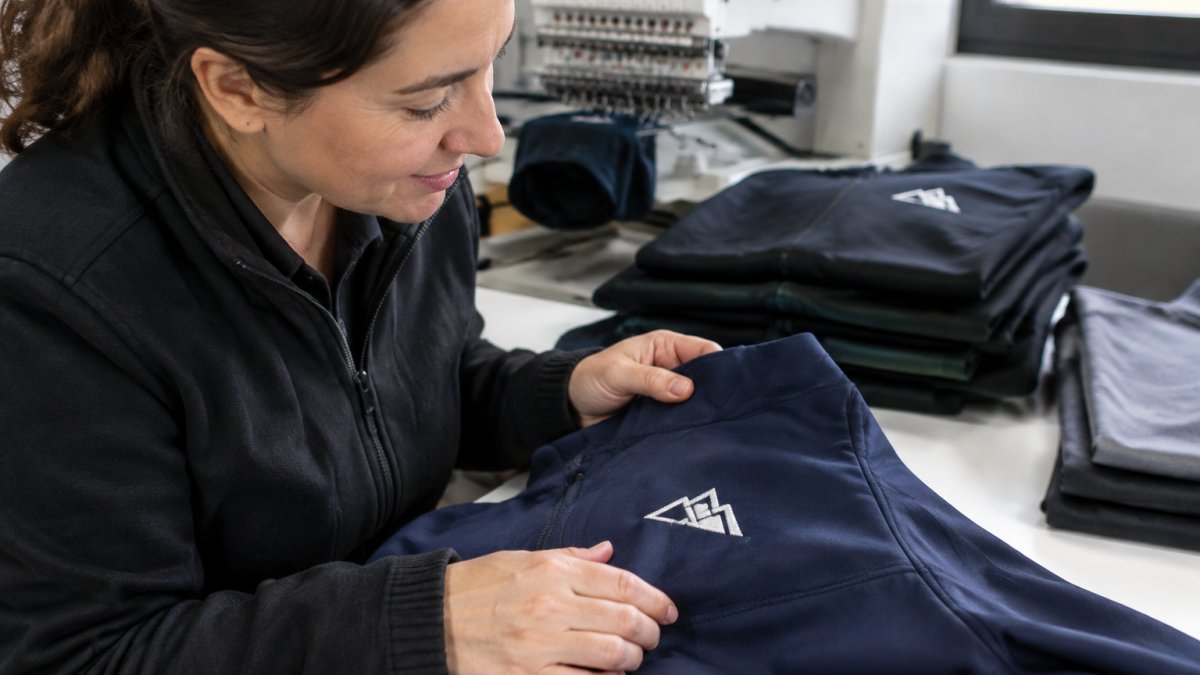
Close-up showing a person inspecting neat embroidery stitching on a navy polo shirt near a workshop window.
Practical sample and proofing checks
Ask for a proof on the actual garment, not a different fabric. Then work through this checklist:
- Logo is centred and level on the chest
- Colours match your brand exactly
- No puckering or rippling around the design
- Text is legible at arm's length
- The garment does not feel stiff where the logo sits
- The back of the embroidery is neat
A common mistake is approving a digital mock-up instead of a stitched sample. Screens flatter everything.
If you are unsure whether your logo file is ready, our guide on preparing a logo for embroidery walks through vector files and stitch settings step by step.
Which Garments Suit Embroidered Company Logo Clothing
Polos, sweatshirts and softshell jackets carry embroidery best, because their fabrics are stable enough to hold dense stitching without distortion. Thin, stretchy or lightweight fabrics are where embroidery struggles.
For most small teams, a piqué polo is the workhorse. Our Embroidered Pro RTX RX101 Pro Piqué Polo Shirt is a 50/50 cotton-polyester blend at 220gsm, which gives a smooth surface for a chest logo and holds its shape through repeat washing. At £14.29, it is the sensible starting point for a first uniform set.
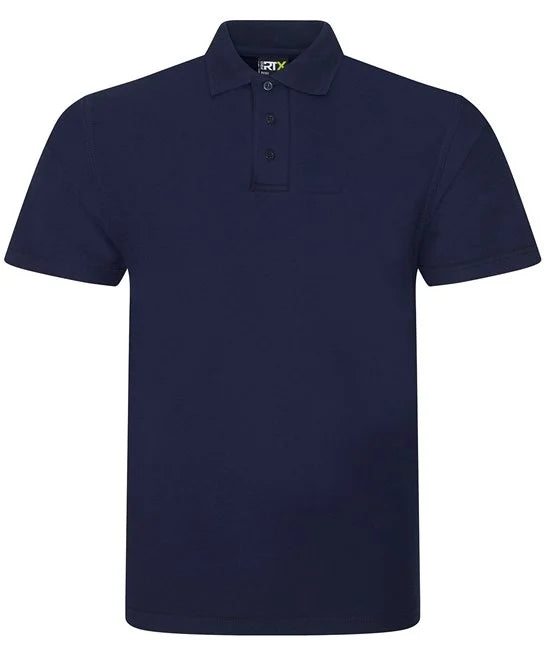
Embroidered Pro RTX RX101 Pro Piqué Polo Shirt
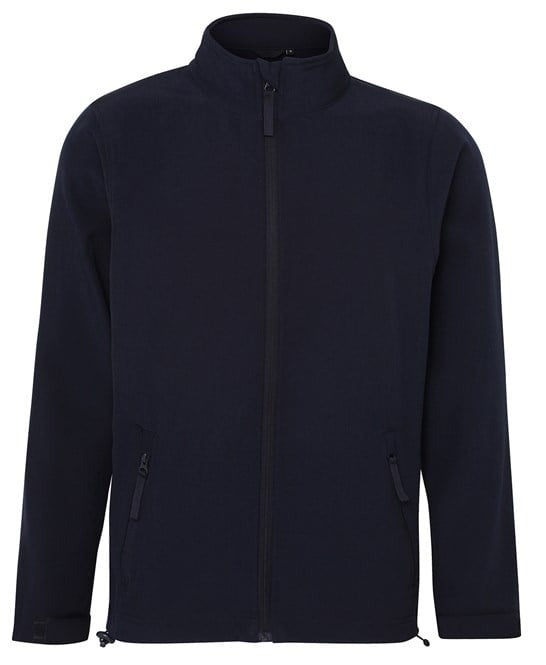
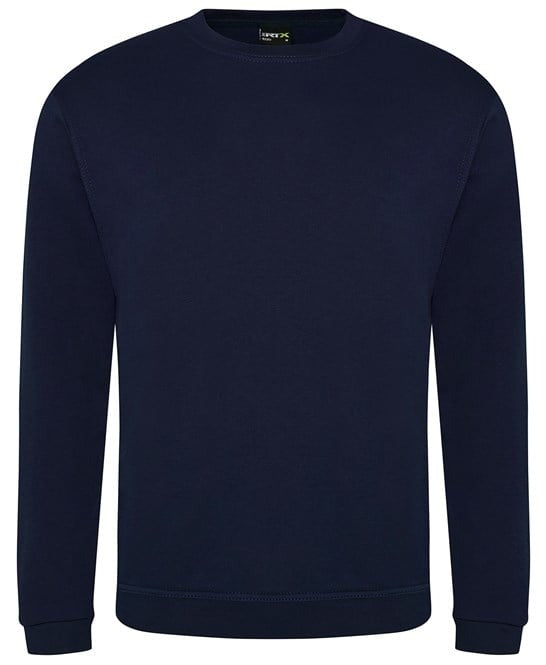
For colder months, the Embroidered RX301 Pro RTX Pro Sweatshirt weighs 300gsm and is built for daily wear. Our Embroidered Pro RTX RX500 Pro 2-Layer Softshell Jacket at £26.39 is windproof and shower-resistant, so outdoor teams stay branded in poor weather.
Hospitality and cleaning teams often do better with lighter pieces. The Embroidered Premier Pocket Tabard at £13.99 and the Embroidered Colours bib apron at £16.49 both take a small chest or pocket logo well.
Matching the logo to the garment
The garment matters, but so does the logo. A bold, blocky logo with thick strokes and few colours will embroider cleanly on almost any stable fabric. A logo with fine text, thin lines, small lettering or gradients is where problems start.
A useful test is to look at your logo at the size it will be stitched. If the smallest text is under about 5mm high, or the lines are hairline thin, expect the embroidery to simplify it. A logo often needs to be simplified, with slightly heavier strokes and fewer fine details, to stitch well at chest size.
Caps are a separate case. The curved front panel and the stiff buckram backing mean caps take a dense, compact logo well, but the design has to be digitised for the curve. A logo that works flat on a polo will not automatically work on a cap without adjustment.
When embroidery is the wrong choice
Embroidery is not always the answer. Very large designs that wrap around the body, logos with photographic detail or subtle gradients, and very lightweight performance fabrics are all cases where embroidery either cannot reproduce the design faithfully or will make the garment uncomfortable to wear. For those, a different decoration method is the better route. The honest test is whether the logo can be simplified into solid shapes and clean lines without losing what makes it recognisable. If it can, embroidery will do it justice. If it cannot, forcing it through embroidery produces a result that looks approximate rather than professional.
If you are still choosing between workwear brands, our roundup of the best workwear brands for embroidery covers which ranges take a logo cleanly.
Small Quantity Embroidered Workwear: What Very Small Teams Can Actually Order
Very small teams can order embroidered workwear in single figures, not just in bulk. Small teams are not required to place bulk orders to get embroidered workwear.
That matters more than it sounds. A tradesperson ordering three polo shirts and a team of fifty ordering the same design should both get the same stitch quality. Where small orders go wrong is when a supplier cuts corners on digitising to keep the price down.
Ask directly whether there is a setup fee for the logo file, and whether it is charged once or per order.
Why repeat orders drift, and how to stop it
The real test of a small-quantity supplier is not the first order. It is the second, third and fourth. Consistency across repeat orders depends on three things being retained: the stitch file, the thread colour references, and the placement specification.
A stitch file is the digitised version of your logo. Keeping it on record helps repeat orders match, so the logo comes out consistent. If the file is lost or re-digitised from scratch, the second run can come out subtly different: a slightly different density, a different edge finish, a different overall size.
Thread colour is the second variable. The same colour name can vary between thread ranges, so it helps when a supplier records the exact thread references used on a first order.
Placement is the third. Logo placement is easier to repeat when the measurement is recorded, since a replacement garment can otherwise sit slightly off.
What to ask before you place a small order
- Will you keep my stitch file on record for future orders?
- Will you record the thread colour references you use?
- Will you record the logo placement measurements?
- Is there a minimum for repeat orders, and is it the same as the first order?
- If I add a new starter in six months, can you match the existing garments exactly?
A supplier who can answer all five clearly is set up for small-business repeat work. One who cannot is set up for one-off bulk runs, and the mismatch will show up on your second order.
You can browse embroidered Pro RTX workwear to see what is available in small quantities.
What to Expect From Workwear Embroidery Services
A workwear embroidery service typically covers the steps from logo to finished garment, and it helps to know what each step involves.
Digitising is the step most buyers underestimate. Someone has to convert your logo into a stitch file, and the quality of that conversion decides how the finished embroidery looks. A well-digitised logo has clean edges, correct underlay, and sensible stitch direction.
Then comes the proof. Insist on seeing it before the run starts.
Finally, delivery. Ask for the dispatch date in writing and check whether it is a promise or an estimate. For event deadlines, order with room to spare.
Our professional embroidery services for business page sets out what the service includes from start to finish.
The Real Cost of Embroidered Uniforms for a Small Team
The true cost of embroidered uniforms is the garment price plus logo setup plus any repeat-order charges, measured over the life of the clothing, not the price of a single item.
Here is how a five-person team might budget a first set, using the listed prices:
Item |
Unit Price |
Qty (5 staff) |
Line Total |
|---|---|---|---|
Pro RTX RX101 Piqué Polo |
£14.29 |
5 |
£71.45 |
Pro RTX RX301 Sweatshirt |
£16.49 |
5 |
£82.45 |
Pro RTX RX500 Softshell Jacket |
£26.39 |
5 |
£131.95 |
Premier Pocket Tabard |
£13.99 |
3 |
£41.97 |
Garment subtotal |
£327.82 |
Line Total
Add any logo setup charge and delivery to the garment subtotal to reach your starting figure.
Ordering Your First Embroidered Workwear Set
Starting with one garment type, one logo placement and a sample before the full order can help avoid first-order problems.
The steps are straightforward:
- Choose your garment and confirm fabric weight suits the logo
- Send your logo in vector format if you have it
- Check the proof before approving it
- Check a physical sample against the list above before a full order
- Confirm the dispatch date before placing a full order
Watch out: sending a low-resolution image pulled from a website is the most common cause of a blurred or simplified logo. Ask for the original design file first.
When you are ready, you can browse custom embroidered Gildan clothing to build your first set.
Getting branded workwear right comes down to checking the details before you commit, not after. Dprintclothing has offered printing and embroidery since 2015, works with reputable brands including Fruit of the Loom, Russell and Gildan, and offers bulk discounts. Whatever the order size, the aim is careful, consistent results. Get started with Dprintclothing to kit your team out in branded workwear.
Frequently Asked Questions
How can I judge the quality of workwear embroidery before ordering?
Ask for a stitched sample on the actual garment you plan to buy, not a digital mock-up. Check that the logo edges are clean with no loose threads, that the backing does not pucker the fabric, and that stitch density looks even across the whole design. Rub the embroidery lightly: cheap work looks fuzzy within a few washes, while tight, well-digitised stitching stays crisp. A supplier confident in their workwear embroidery quality will send a sample without hesitation.
Can small businesses order small quantity embroidered workwear?
Small quantity orders can be discussed with the supplier. It is worth asking upfront about minimum order quantities and whether setup or digitising fees apply to short runs. Confirm the minimum before you send artwork so there are no surprises at quote stage.
Which garments work best for embroidered company logo clothing?
Polos, sweatshirts, softshell jackets and aprons all take embroidery well because the fabric is stable enough to hold stitching without distortion. A 220gsm poly-cotton polo like the Pro RTX RX101 gives a smooth surface for a chest logo, while a 300gsm sweatshirt handles larger designs. Avoid very thin or stretchy fabrics for detailed logos. Match the garment weight to the job: lightweight for indoor hospitality, heavier layers for trades and outdoor teams.
What should I ask a workwear embroidery services provider before ordering?
Ask four things: what the minimum order is, whether digitising is included or charged separately, what turnaround and delivery look like, and whether they will stitch a sample first. Also confirm how they handle repeat orders so your second batch matches the first. A supplier that answers these plainly, with fixed prices in writing, is usually the safer choice for small business workwear.