

Best Workwear Brands for Embroidery: A Practical Guide
Last Updated: November 8, 2026
Quick Summary
The best workwear brands for embroidery are those whose garments hold dense stitching without puckering, keep shape through washing, and offer a stable, flat surface. Look for mid-weight fabrics like 220gsm poly-cotton piqué, 280gsm softshell and 300gsm fleece, with reinforced seams and stable panels.
- Poly-cotton blends, dense polyester fleece and softshell hold embroidery stitches better than lightweight pure cotton.
- The Pro RTX RX101 polo is a 220gsm 50/50 cotton-polyester blend with a classic fit.
- The Pro RTX RX500 softshell is 280gsm, windproof and shower-resistant for trade and outdoor teams.
- The Pro RTX RX402 fleece uses 300gsm anti-pill polyester for colder-weather site crews.
- High-wash uniforms favour embroidery, while complex gradients print better.
Table of Contents
- What Separates the Best Workwear Brands for Embroidery
- Workwear Fabric for Embroidery: What Holds a Stitch Best
- The Best Jackets for Embroidery in the Range
- The Best Polo Shirts for Embroidery and Everyday Uniforms
- Embroidery vs Printing on Workwear: Which Branding Lasts
- Total Cost of Branded Workwear and Logo Longevity
- Matching Garments to Trades and Team Needs
- Building Your Embroidered Uniform Order
- Frequently Asked Questions
What Separates the Best Workwear Brands for Embroidery
The best workwear for embroidery is garment that holds a dense stitch pattern without puckering, keeps its shape through repeated washing, and gives your embroiderer a stable, flat surface to work on. At Dprintclothing, we offer custom workwear, and the difference between a logo that stays sharp and one that ripples often comes down to the garment itself.
Three things decide the outcome:
- Fabric weight and density. A 180gsm jersey pulls and distorts under a dense logo. A 280gsm softshell or 300gsm fleece holds tension far better.
- Fibre blend. Polyester-cotton blends grip thread well. Pure synthetics can slip; loose knits can stretch.
- Construction. Reinforced seams, a stable placket and a flat chest panel all give the needle an even surface.
Get these right and embroidery looks like part of the garment. Get them wrong and you get the puckered, stiff patch most people associate with cheap company uniforms. Below, we break down which garments in our range actually deliver, and where each one earns its place on a trade team.
Selection Criteria: Fabric, Stitch Density and Garment Construction
We judge every garment on three tests. First, stitch density tolerance: can the fabric carry a logo of 8,000 to 12,000 stitches without the surrounding weave bunching? Second, wash durability: does the embroidery stay flat after repeated cycles? Third, construction quality: are the seams reinforced and the panels stable? Together, these tests show that choosing quality custom embroidery depends on matching the design and garment construction so the finished logo remains stable through wear and washing.
The UK Health and Safety Executive guidance on protective clothing is a useful reminder that workwear also has a job to do on site. Embroidery should never compromise that. A logo stitched through a waterproof membrane, for instance, can break the seal. That is why placement matters as much as the garment itself.
Workwear Fabric for Embroidery: What Holds a Stitch Best
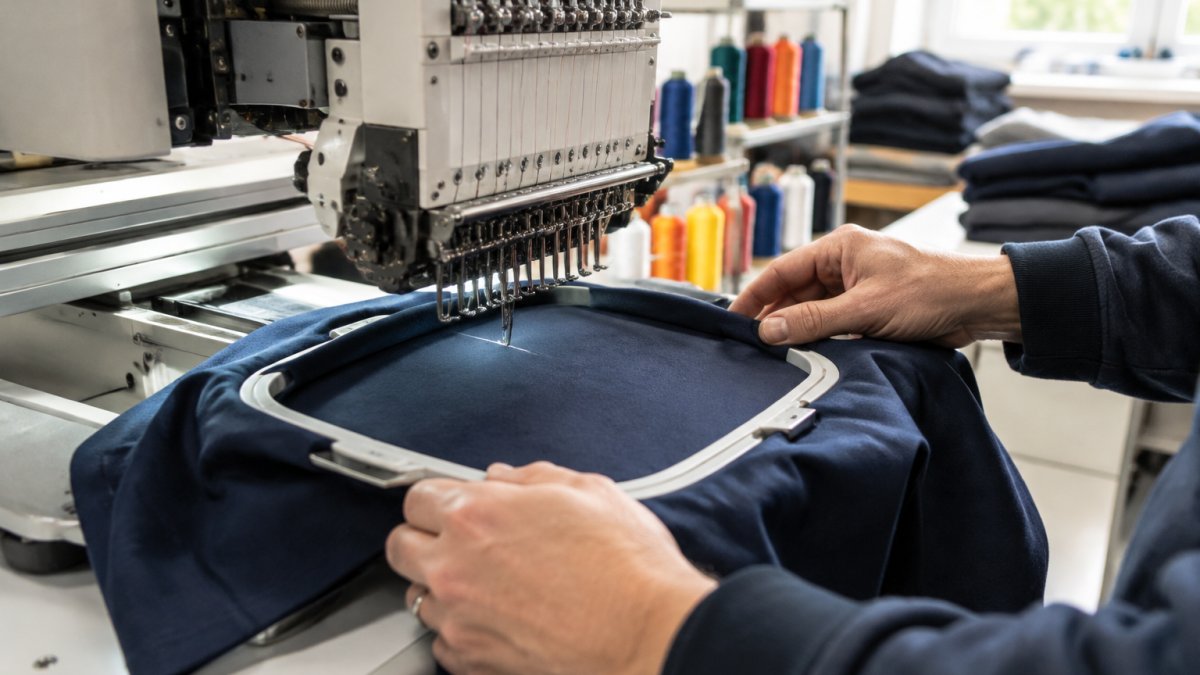
Polyester-cotton blends hold embroidery stitches well, as do dense polyester fleece and softshell. Pure lightweight cotton distorts more easily under dense logos. The reason is mechanical: a stitch pulls the weave around it, so the fabric has to resist that pull without stretching or bunching. Stable, tightly woven mid-weight fabrics do that; loose knits and thin jerseys do not.
Here is how the common fabrics behave, and what to watch for on each:
- 50/50 poly-cotton piqué (220gsm): the RX101 polo is made from this blend, which combines cotton and polyester for a stable, washable finish.
- 100% polyester anti-pill fleece (300gsm): the RX402 fleece is made from this material.
- Polyester-elastane softshell (280gsm): the RX500 softshell is made from this blend and offers flexibility for movement.
- Poly-cotton twill (195gsm): the fabric used for the Colours bib apron.
Placement matters as much as fabric, so consider where a logo will sit on the garment.
If you want a deeper look at picking fabric that survives daily wear, our guide on how to choose durable workwear fabric that lasts compares cotton, polyester and blends by weight, weave and care.
The Best Jackets for Embroidery in the Range
The best jackets for embroidery in our range are the Pro RTX RX500 softshell and the Regatta Ablaze softshell, with fleece options for colder teams. Both give a flat chest panel, a stable fabric weight and enough structure to carry a detailed logo cleanly.
Softshell Jackets: Pro RTX RX500 and Regatta Ablaze
The Pro RTX RX500 Pro 2-Layer Softshell (£26.39) is a softshell suited to trade and outdoor teams. It has a 280gsm build and is windproof and shower-resistant.
The Regatta Ablaze softshell (£24.19) is available in men's and women's fits at 265gsm, and our online designer allows for larger designs or logos, which suits team uniforms and corporate events.
For colder months, the Pro RTX RX402 Pro Fleece (£23.64) uses 300gsm anti-pill polyester. The Premier Artisan Fleece Gilet (£27.99) is a sleeveless 260gsm fleece gilet that keeps arms free for everyday tasks.
Best for: site teams and outdoor crews needing weather protection with clear branding.
You can view the Regatta Professional Ablaze men's printable softshell and the women's Ablaze softshell to order the right fit across a mixed team.
Garment prices for embroidered workwear
The Best Polo Shirts for Embroidery and Everyday Uniforms
The Pro RTX RX101 Pro Piqué Polo (£14.29) is a 220gsm 50/50 cotton-polyester blend with a classic fit. You can view the Pro RTX RX101 Pro Piqué Polo Shirt to check the details and place your order.
Best for: front-of-house teams, event staff and trades who want a smart, washable uniform. For a ready-to-embroider option, see the Embroidered Dryblend® Adult Jersey Polo and add it to your uniform order.

Embroidery vs Printing on Workwear: Which Branding Lasts
Embroidery is a durable way to brand workwear. Stitched logos are part of the garment, whereas printed graphics sit on the surface.
The decision usually comes down to three questions:
- How often will it be washed? High-wash uniforms favour embroidery.
- How complex is the design? Simple logos stitch cleanly; complex gradients print better.
- How long must it last? For a logo that represents your business for years, embroidery wins.
The British Standards Institution guidance on textile care labelling is worth checking so your care instructions protect the stitching as well as the fabric.
Total Cost of Branded Workwear and Logo Longevity
The true cost of branded workwear is the garment price plus the one-off setup costs plus how long the branding lasts. A cheaper item that fades in a year can cost more over time than an embroidered garment that stays sharp for several. Most buyers compare only the garment price and are surprised by the setup line on the quote, so it pays to know what makes up the total before you commit.
A branded order has several cost components:
- Garment price. The per-item cost, which falls with bulk quantity. The RX101 polo at £14.29 is a useful benchmark for a mid-weight embroidered polo; a softshell at £24.19 to £26.39 sits above it because of the fabric and construction.
A polo at £14.29 is a useful benchmark for a mid-weight embroidered garment.
Care affects how long a garment keeps its appearance, so follow the care label on each garment.
Matching Garments to Trades and Team Needs
Different trades need different garments, and the embroidery should follow the work. Here is how we match them:
Team or trade |
Recommended garment |
Why it works |
|---|---|---|
Building and outdoor trades |
Pro RTX RX500 softshell |
Windproof, shower-resistant, stable for logos |
Cold-weather site crews |
Pro RTX RX402 fleece or Artisan gilet |
300gsm and 260gsm warmth, flat chest panel |
Hospitality and catering |
Colours bib apron |
195gsm twill, easy-care, smart logo placement |
Front-of-house and retail |
RX101 piqué polo |
Smart, washable, holds a crisp stitch |
Event and promo crews |
Regatta Ablaze softshell |
Lightweight, large-logo friendly, men's and women's fits |
The Embroidered Colours Bib Apron (£16.49) is a 65/35 poly-cotton twill at 195gsm with an adjustable neck strap, suited to hospitality, catering and retail.
Watch out: confirm logo placement before a bulk run.
Building Your Embroidered Uniform Order
Start with the garment that does the hardest job, then build the layers around it. For most trade teams that means a softshell or fleece for outdoor work, a polo for warmer days, and a gilet or apron where the role demands it.
Order in three steps:
- Confirm the garment and fabric weight suit the work and the logo size.
Getting the fit right across a mixed team matters as much as the branding, so order men's and women's cuts where available.
The real test of branded workwear is how it looks after a year of washing and daily wear, not on the day it arrives. That is where garment choice and stitch quality show. At Dprintclothing, we offer both embroidery and printing, bulk discounts for larger orders, and a simple online ordering process, so you can build a uniform that stays sharp. Get started with Dprintclothing and give your team workwear that carries your logo properly, season after season.
Frequently Asked Questions
What workwear fabric is best for embroidery?
Medium to heavy fabrics hold embroidery best. Polyester-cotton blends around 220gsm, like the Pro RTX RX101 polo, are a 50/50 cotton-polyester blend. Fleece at 260-300gsm, such as the Premier Artisan Gilet and Pro RTX RX402, is available in those weights.
Is embroidery durable on workwear?
Embroidery stitches the design directly into the fabric rather than sitting on top of it. Ask us about wash-care guidance before a bulk order.
Can you embroider logos on jackets and fleeces?
Yes. We offer embroidery on jackets and fleeces, including the Pro RTX RX500 softshell, Regatta Ablaze softshell and Thor III fleeces.
What should I look for when choosing workwear for embroidery?
Check the fabric weight and blend, and the range of sizes across your team. Garments such as the RX101 polo (220gsm) or RX402 fleece (300gsm) are available in these weights.
Is embroidery suitable for small logos on workwear?
Small logos can be embroidered on workwear. Simpler designs tend to suit smaller logos best.

