Embroidered vs Printed Shirts: Which Suits Your Brand?
Last Updated: November 8, 2026
Quick Summary
Choose embroidered shirts for small logos, chest badges and workwear that gets washed hard, because stitched thread resists fading, cracking and peeling. Choose printing for large, detailed or full-colour artwork that thread cannot reproduce. Match the method to your artwork and you get a professional finish either way.
- Embroidery suits simple two or three colour logos, while printing handles gradients, fine text and photos.
- A heavy stitch count on a lightweight tee can feel stiff, so use 180gsm or heavier garments.
- Wash at 30°C or lower, turn garments inside out and skip the tumble dryer to protect both finishes.
- Loose embroidery threads can be trimmed or re-stitched, but cracked or peeled print cannot be restored.
- Trade workwear and corporate polos suit embroidery, while event tees and sports kits suit printing.
Table of Contents
- Embroidered Shirts vs Printed Shirts: The Quick Comparison
- Embroidery vs Printing for Logos: Which Method Fits Your Design?
- Embroidered Workwear vs Printed Workwear: Appearance, Comfort and Fabric
- Embroidery vs Printing Durability: Wash Resistance and Fading
- Cost per Garment: Design Size, Order Quantity and Setup
- How to Care for Embroidered Shirts and Printed Shirts
- Choosing Your Decoration Method: A Use-Case Guide
- Ordering Your Custom Shirts from Dprintclothing
- Frequently Asked Questions
Embroidered Shirts vs Printed Shirts: The Quick Comparison
Choosing between custom embroidered shirts vs printed shirts comes down to one question: does your logo need to look stitched and permanent, or bold and full-colour? Embroidery builds your design in thread, so it suits small chest badges and workwear that gets washed hard.
Here is the short version before we break it down properly:
Factor |
Embroidered Shirts |
Printed Shirts |
|---|---|---|
Best for |
Small logos, chest badges, workwear |
Large designs, full-colour artwork |
Texture |
Raised, stitched finish |
Flat, smooth surface |
Durability |
Very high, resists repeated washing |
High, but can crack or fade over time |
Colour range |
Limited to thread colours |
Unlimited shades and gradients |
Detail level |
Simple shapes and text |
Fine detail, photos, gradients |
Setup |
Design digitised for stitching |
Artwork prepared for print |
Typical garment price |
From £11.54 |
From £13.74 |
The one thing most buyers get wrong is assuming one method is simply "better". A detailed crest with six colours will look muddy in thread; a two-letter monogram will look cheap printed on a polo. Match the method to the artwork and you get a professional finish either way.
Embroidery vs Printing for Logos: Which Method Fits Your Design?
Embroidery vs printing for logos is really a question about your artwork, not your budget. If your logo is simple, bold and uses two or three colours, embroidery wins on perceived quality. If it has gradients, fine text or photographic elements, printing is the only method that will do it justice.
Simple logos and small chest badges
Thread works best when it has room to build clean shapes. A wordmark, an icon, or a small chest badge above the pocket is exactly what embroidery was made for. The stitched texture reads as premium, and the design holds its shape through years of washing.
A left-chest logo is the classic corporate apparel choice for good reason.
Detailed artwork, gradients and full-colour designs
Printing handles complexity that thread cannot. Gradients, drop shadows, thin type and multi-colour illustrations all translate cleanly to print. Full-colour designs are where printed shirts leave embroidery behind.
The trade-off is surface feel. Print sits on top of the fabric, so large solid areas can feel slightly stiffer than the garment around them. On a well-chosen fabric, most wearers never notice.
Embroidered Workwear vs Printed Workwear: Appearance, Comfort and Fabric
Embroidered workwear vs printed workwear comes down to how each finish ages on a working garment. Embroidery adds a raised, textured patch that looks and feels premium, and it stays sharp through industrial washing.
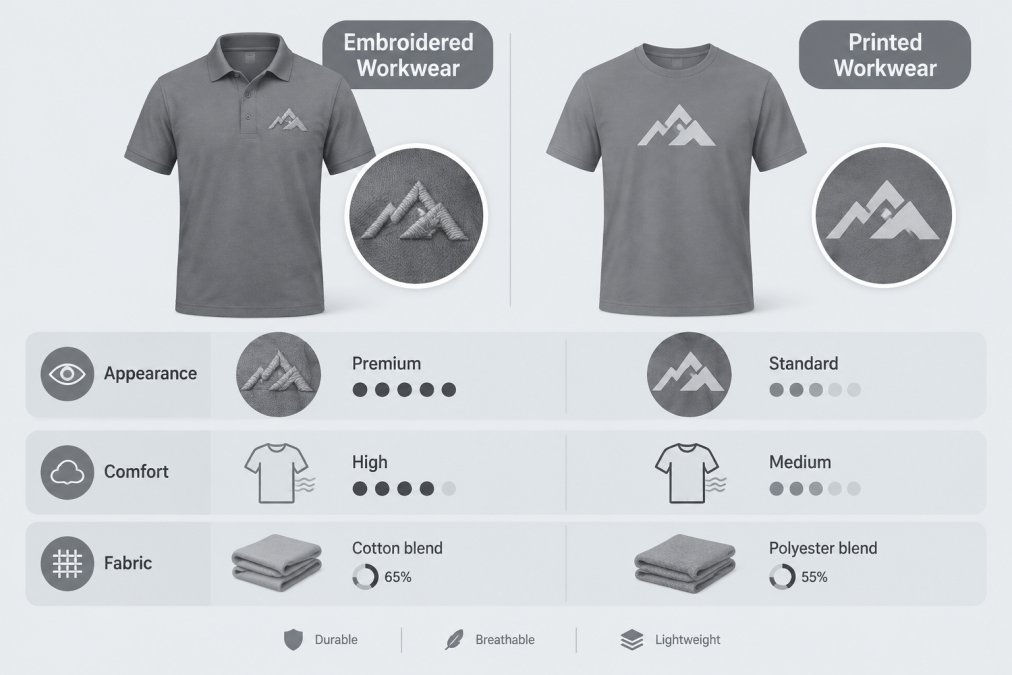
Comfort is where fabric weight matters. A heavy stitch count on a lightweight tee can feel stiff against the skin, especially on the chest. On a 180gsm or heavier garment, the same embroidery sits comfortably.
Fabric choices that affect the finish
Not every fabric takes embroidery equally well. Loose-knit or very stretchy fabrics can pucker under dense stitching, and thin cottons may distort around a large design. A midweight cotton or cotton-poly blend gives thread a stable base.
If fabric durability is your main concern, our guide on how to choose durable workwear fabric that lasts compares cotton, polyester and blends by weight and weave, which helps you pick a garment that holds its finish.
Embroidery vs Printing Durability: Wash Resistance and Fading
Embroidery vs printing durability is not a close contest in one direction: thread outlasts ink, but print quality has improved enormously and a well-made print survives years of normal washing. Printed designs sit on the surface, where repeated washing, abrasion and heat slowly wear the bond between ink and fabric.
How each method fails
Embroidery fails in predictable ways. Loose or broken threads appear where a stitch has been snagged on a zip, velcro or a sharp edge. Puckering shows up when dense stitching pulls a lightweight or stretchy fabric out of shape. Bobbin thread may show through on the reverse if the design is badly digitised.
Printing fails differently. Cracking appears when the ink film is stretched over seams or a high-flex area and then washed at high heat. Fading comes from UV exposure and repeated washing, and is most visible on darker garments.
- Embroidery: resists fading, cracking and peeling; colour comes from thread, not dye; main risks are snagging and puckering on unsuitable fabric
- Printing: can fade or crack over time, especially on high-wear areas like elbows, hems and across seams; edges are the first to go
- Both: last longer when washed inside out at lower temperatures and kept out of a hot tumble dryer
Fabric and construction decide the outcome
Durability is not only about the decoration method, the garment underneath matters as much. Embroidery needs a stable base: a midweight cotton or cotton-poly blend holds dense stitching without distorting, while loose-knit or very stretchy fabrics pucker and thin cottons can distort around a large design. Fabric weight and stitch density need to be matched.
Print adhesion depends on the fabric surface and how the garment is constructed. Prints that cross seams or sit on high-stretch panels are more likely to crack because the ink film cannot move with the fabric.
Care habits that prevent premature failure
Most durability problems are care problems. Iron printed shirts inside out and never directly on the design; press around an embroidered logo rather than over it, because direct heat flattens the stitching and leaves a shiny mark.
Watch out: washing workwear with items that have zips or velcro is the most common cause of snagged embroidery, so wash those separately or fasten zips before washing.
Repair and longevity
Embroidery has the edge on repairability. A loose thread can be trimmed, a small pull re-stitched, and the design continues to look sharp because the colour is in the thread. Print damage is generally permanent, once ink has cracked or peeled, it cannot be restored, and the only remedy is reprinting the garment. For uniforms and workwear that will be washed hard for years, that repairability is a genuine long-term advantage; for promotional and event shirts with a shorter life, a good print is more than durable enough.
Cost per Garment: Design Size, Order Quantity and Setup
Cost per garment is where most comparisons stay vague, so it is worth being concrete about what actually moves the number. Three variables dominate: the size of the decorated area, the quantity in the run, and the amount of preparation your artwork needs before production. Garment choice sits underneath all three, because a heavier or more expensive shirt raises the base cost regardless of decoration method.
How design size changes the price
Decoration cost generally rises with the size of the design and the number of colours involved, so a small chest logo and a large full-colour back design will not cost the same.
How quantity changes the price
Setup is a one-off cost that gets spread across the run. because the preparation is amortised across more garments.
What artwork preparation adds
A common pattern is that the cheapest quote is the one with the cleanest artwork. Supplying a proper vector file, specifying colours precisely, and keeping embroidery designs to bold shapes removes preparation time and the associated charge.
A like-for-like way to compare
The Embroidered Ultra Cotton Adult T-Shirt is listed at £11.54 and the Pro RTX RX151 T-Shirt at £14.29.
How to Care for Embroidered Shirts and Printed Shirts
How to care for embroidered shirts and printed shirts is simpler than most people expect: wash cool, turn inside out, and skip the tumble dryer. These three habits protect both thread and print far better than any specialist product.
- Wash at 30°C or lower on a gentle cycle
- Turn garments inside out before washing
- Avoid fabric softener, which can break down threads and print adhesives
- Skip the tumble dryer, or use a low heat setting
- Iron printed shirts inside out, never directly on the design
- Wash workwear separately from items with zips or velcro that can snag stitching
Watch out: ironing directly over an embroidered logo can flatten the stitching and leave a shiny mark, so press around the design or use a cloth barrier.
Choosing Your Decoration Method: A Use-Case Guide
Choosing your decoration method gets much easier once you match it to a real scenario. Here is how we would decide for the most common orders.
- Trade and site workwear: embroidery, for a durable chest logo that survives hard washing
- Event and promotional tees: printing, for large, colourful designs at volume
- Corporate polos: embroidery, for a subtle, premium left-chest badge
- Sports team kits: printing for large numbers and names, embroidery for the club crest
- One-off personalised gifts: either method works, and small designs keep costs down
For logos specifically, our step-by-step guide on how to scale a logo for embroidery covers measuring, sizing and placing your design so it stitches cleanly. If you are ready to see real options, you can browse the embroidered t-shirts and polos range to compare garments for your brand.
Ordering Your Custom Shirts from Dprintclothing
Ordering from Dprintclothing lets you choose embroidery or printing for your order.
For the full picture on garment options, our guide to custom logo clothing for companies, and you can browse the premium custom printed apparel collection to see printed options in practice.
The real challenge is not picking a method, it is getting a straight answer on cost and turnaround before you commit.
Frequently Asked Questions
What is the difference between embroidered and printed shirts?
Embroidered shirts have the design stitched into the fabric with thread, so the logo sits slightly raised and has a textured finish. Printed shirts apply ink or a film to the surface of the garment, which allows full-colour artwork and fine detail. Embroidery suits small, simple logos such as a chest badge, while printing handles large graphics, gradients and multi-colour designs. The right choice depends on your artwork, the garment type and how the shirts will be worn and washed.
Do embroidered shirts last longer than printed shirts?
Embroidery is stitched directly into the fabric, so it does not crack, peel or fade in the wash the way a surface print can. On workwear that is washed weekly, embroidered logos usually keep their appearance for the life of the garment. Printing durability depends on the method and the care taken, and prints on high-wear areas can degrade faster. For uniforms and trade workwear, embroidery vs printing durability usually favours embroidery.
Is embroidery or printing better for a logo?
For a simple logo with solid shapes and limited colours, embroidery gives a professional, textured finish that reads well on polo shirts and work jackets. For logos with fine text, gradients or many colours, printing reproduces the artwork more accurately. A common approach is to embroider a small chest logo and print a larger back design. Think about where the logo sits and how detailed it is before deciding.
Can you embroider a T-shirt, and which fabrics work best?
Yes, you can embroider a T-shirt. Medium-weight cotton and cotton-polyester blends hold stitching well without distorting. Lightweight or very stretchy fabrics can pucker under dense embroidery, so a slightly heavier tee is safer. The Embroidered Ultra Cotton Adult T-Shirt at £11.54 (205gsm, 100% cotton) and the Embroidered Pro RTX RX151 T-Shirt at £14.29 (180gsm, 50% cotton, 50% polyester) are both suitable bases for a stitched logo.
How do you care for embroidered and printed shirts?
Wash embroidered shirts inside out on a cool cycle and avoid tumble drying on high heat, which can shrink the fabric around the stitching. Printed shirts should also be washed inside out, and you should avoid ironing directly over the print or the embroidery. Skip fabric conditioner on decorated areas where possible. Following the care label and turning garments inside out keeps both finishes looking sharp for longer.