

The Complete Guide to Custom Logo Clothing for Companies
Last Updated: October 26, 2026
Quick Summary
Custom logo clothing is branded apparel decorated with a company's logo, name or artwork, ordered in quantities from single garments to full staff uniforms. Embroidery suits most company logos on polos, sweatshirts and jackets, while printing suits large, multi-colour or photographic designs. Decide the garment and the decoration method together before you request pricing.
- Send vector artwork in EPS, PDF or AI format so colours can be separated for stitching.
- A typical order runs through five stages: quote, artwork approval, proof sign-off, production and delivery.
- Wash embroidered garments inside out at a moderate temperature, with 30°C a sensible default for most workwear.
- Confirm whether quoted prices include VAT, as it changes the real cost of a bulk order considerably.
- Allow at least two weeks from approved artwork to delivery for a typical bulk order.
Table of Contents
- Choosing Custom Logo Clothing for Companies
- Embroidery or Printing: Which Decoration Method Fits Your Logo
- Branded Workwear That Holds Up on Site and in Front of Clients
- Embroidered Workwear: Garment Ranges, Prices and Bulk Discounts
- Personalised Workwear for Events, Teams and Promotional Campaigns
- Preparing Logo Artwork and Sizing Your Order Correctly
- The Ordering Timeline, Care Advice and Ethical Sourcing
- Request a Quote for Your Custom Logo Clothing
- Frequently Asked Questions
Choosing Custom Logo Clothing for Companies
Custom logo clothing is branded apparel decorated with a company's logo, name or artwork, ordered in quantities from single garments to full staff uniforms. At Dprintclothing, we have supplied embroidered and printed workwear since 2015, and the single biggest mistake we see is buyers choosing garments before they have decided how the logo will be applied. Get that order right and everything else follows.
The second mistake is buying on headline price alone. A cheap polo that fades after fifteen washes costs more per wear than a better one that lasts three years. Below, we break down decoration methods, garment ranges, artwork preparation and the full ordering timeline, so you can brief a supplier properly and compare quotes on equal terms.
Embroidery or Printing: Which Decoration Method Fits Your Logo
Embroidery suits most company logos on polos, sweatshirts and jackets; printing suits large, multi-colour or photographic designs. Stitched logos use coloured threads matched to your brand palette, giving a raised, hardwearing finish that survives industrial washing. It is the default choice for corporate clothing and staff uniforms.
Printing handles what thread cannot: gradients, fine detail, photographic imagery and very large chest or back designs. The trade-off is that prints sit on the fabric surface, so placement and care matter more.
Use this comparison to decide:
Method |
Best for |
Fabric suitability |
Durability |
Appearance |
Order size sweet spot |
|---|---|---|---|---|---|
Embroidery |
Logos, names, small text, workwear |
Polos, sweatshirts, softshells, caps, aprons; not ideal on very lightweight or stretch performance fabrics |
Very good, survives repeated industrial washing |
Raised, textured, premium |
Any size; setup cost amortises over volume |
Large graphics, many colours, photos |
Cotton and poly-cotton tees, hoodies, aprons |
Good with correct washing; can crack at folds if stretched |
Flat, photographic, full-colour |
Better value at larger quantities |
|
Heat transfer |
Names, numbers, fine detail, small runs |
Performance fabrics, polyester, kit |
Variable, depends on application and care |
Flat, precise, can feel stiff |
Small to medium runs |
A common mistake is sending a low-resolution logo and hoping the supplier will "clean it up". They cannot, and the result looks amateur on a client-facing uniform. The second common mistake is choosing a method before checking the garment: a stitch-heavy logo on a lightweight performance tee will pucker, and a large print on a textured fleece will sit unevenly. Decide the garment and the decoration together, not in sequence.
Branded Workwear That Holds Up on Site and in Front of Clients
Durability is a specification decision, not a brand promise. Look at fabric weight and blend before anything else. A 300gsm poly-cotton sweatshirt holds its shape through repeated washing; a lightweight tee will not. For outdoor and client-facing roles, a softshell adds wind and shower resistance while staying flexible enough to work in.
Our embroidered Pro RTX RX500 Pro 2-Layer Softshell Jacket is the garment we point trade teams towards when they need something that looks smart on a site visit and survives the van. It is made from a 2-layer polyester softshell with a 280gsm weight, and embroidery sits cleanly on the chest.

What most guides miss is that sleeves, hems and necklines fail first. Ribbed cuffs and a taped neckline are small details that decide whether a uniform still looks presentable in year two.
Embroidered Workwear: Garment Ranges, Prices and Bulk Discounts
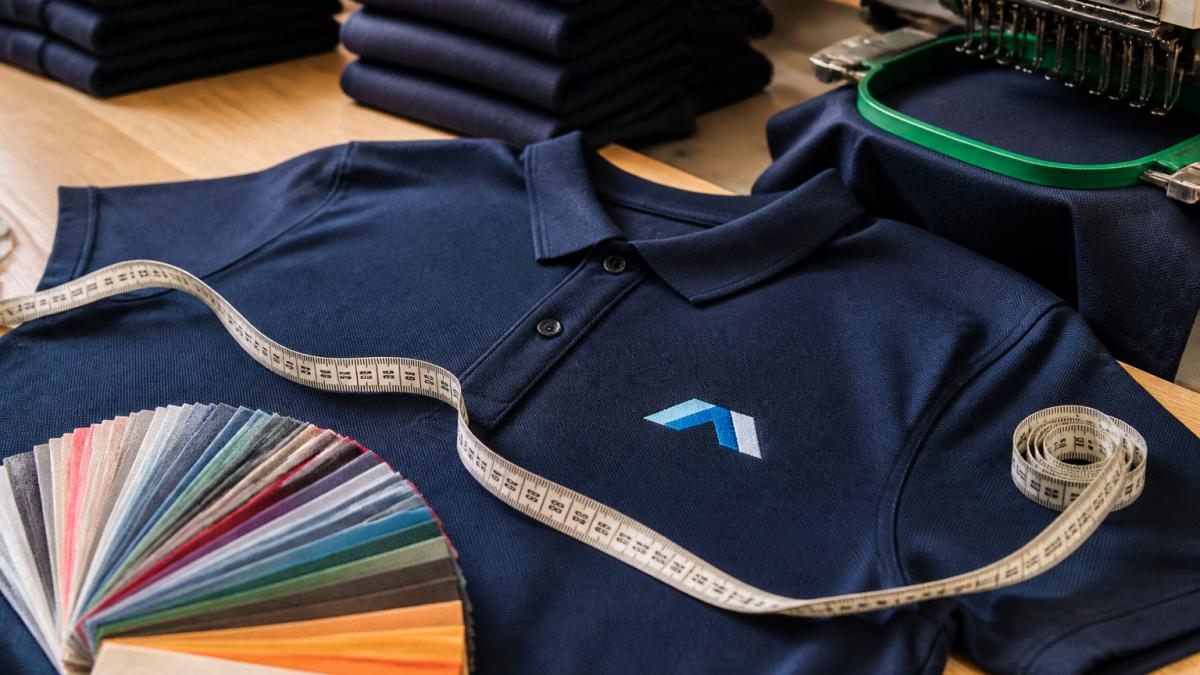
Embroidered workwear covers polos, tees, sweatshirts, softshells and aprons, and pricing depends on garment, quantity and stitch count. Our embroidered Pro RTX RX101 Pro Piqué Polo Shirt is £14.29 per garment, a 220gsm 50/50 cotton-polyester blend with reinforced stitching. The RX151 T-Shirt is also £14.29 at 180gsm, the RX301 Pro Sweatshirt is £16.49 at 300gsm, and the Colours bib apron is £16.49.
Those are per-garment prices before decoration, and bulk discounts apply as quantities rise. Ask for a quote that itemises garment, embroidery and any setup separately, so you can compare suppliers fairly.
If you want to see exactly what you would be ordering, you can view the embroidered polo shirt and check sizing and colourways before you commit.

Personalised Workwear for Events, Teams and Promotional Campaigns
Promotional clothing works hardest when it is worn repeatedly, not handed out once. For events, order garments people will actually keep: a decent tee or hoodie with a clean one-colour logo beats an elaborate design on a thin shirt. Team clothing should carry names and numbers where relevant, and club colours should be matched as closely as the thread range allows.
For campaigns, keep the artwork simple and place the logo where it will be seen in photographs. Hospitality and retail teams often need aprons alongside tees, and a bib apron with an embroidered logo reads far more professional than a printed one that cracks at the fold.
Ordering for a one-off event? Build in a buffer. Sizes get collected late, and a handful of spare garments in the middle sizes saves a scramble.
Embroidered Pro RTX RX101 Pro Piqué Polo Shirt →
Preparing Logo Artwork and Sizing Your Order Correctly
Send a vector file wherever possible: EPS, PDF or AI. Vector artwork scales without losing quality and lets us separate colours for stitching. If you only have a JPG or PNG, send the highest-resolution version you have, and we will tell you honestly whether it will reproduce well.
For embroidery, we match thread colours to your brand palette, so specify any Pantone references you hold. Approve the digital proof before production starts; that proof is your last cheap chance to catch a wrong colour or a misspelt name.
Sizing is where most orders go wrong. Collect sizes from staff rather than guessing, and remember that workwear is often worn over other clothing. Our guide to custom embroidery walks through the artwork and setup process in more detail, and you can start your order once your logo file and size breakdown are ready.
The Ordering Timeline, Care Advice and Ethical Sourcing
Ordering custom printed or embroidered clothing doesn't have to be complicated. At Dprintclothing, you can choose your garments, upload your logo or design, and place your order directly through our website. Whether you're ordering a few T-shirts or clothing for an entire team, the process is much the same.
Start by selecting the garment, colour, size and quantity you need. Our online customisation tool allows you to add your own logo, text or artwork and see how it looks on the clothing before placing your order. Once you're happy with your design, simply add the items to your basket and complete checkout.
After receiving your order, we prepare the garments for printing or embroidery. Depending on the product and design, we use DTF printing, vinyl printing or professional embroidery equipment. Each item is checked before being packed and dispatched.
Production times depend on the size of your order, garment availability and the type of decoration required. Smaller orders are generally quicker to prepare, while larger workwear orders may take longer. If you're ordering for an upcoming event, a new team or a particular deadline, it's always worth allowing some extra time.
For businesses ordering uniforms, we recommend checking everyone's sizes before placing the order. It's also worth considering a few spare garments, particularly if you regularly take on new staff.
Looking after your custom clothing is just as important as choosing the right garment. Printed and embroidered clothing can last a long time when cared for properly. Turning garments inside out before washing, using a gentle cycle and following the manufacturer's care instructions will help protect both the fabric and decoration. A 30°C wash is a sensible option for many garments, provided the care label allows it.
Avoid ironing directly over printed designs or embroidery, and try to avoid excessive heat when drying. Air drying is often the better option, particularly for clothing with printed logos.
When choosing workwear, it's also worth paying attention to the quality and durability of the garments themselves. Clothing that holds its shape and withstands regular washing can offer better long-term value than simply choosing the cheapest option. If ethical sourcing is important to your business, look for information about the garment manufacturer's production standards and any independently verified certifications.
Finally, remember to compare the overall cost rather than just the price of the garment. At Dprintclothing, our website prices include VAT, and we offer bulk discounts for larger orders. Delivery costs are shown during checkout, so you can review the total before completing your purchase.
Choosing suitable garments, preparing your design and allowing enough time for production will help make the ordering process straightforward, whether you're buying one personalised T-shirt or uniforms for a whole team.
Request a Quote for Your Custom Logo Clothing
Getting pricing right starts with a clear brief: garment type, quantity, size breakdown, logo file and deadline. Send those four things and a quote should come back quickly rather than after a week of emails.
At Dprintclothing, we offer both embroidery and printing, work with established garment brands including Fruit of the Loom, Russell and Gildan, and apply bulk discounts as quantities grow. We handle single garments and large corporate orders through the same straightforward process, with fast delivery once artwork is approved.
Get started with Dprintclothing and kit your team out in custom logo clothing that still looks right a year from now.
Frequently Asked Questions
How can I put my company logo on clothing?
You send your logo artwork, usually a vector EPS or PDF file, and choose a decoration method. Embroidery stitches the logo into the fabric, which suits polos, sweatshirts and jackets; printing works better for detailed multicolour designs. You approve a digital proof before production starts, and Dprintclothing can set up artwork for you if you only have a low-resolution image.
Should a company logo be embroidered or printed on clothing?
Embroidery suits embroidered workwear such as polos, sweatshirts and softshell jackets because the stitching lasts as long as the garment and keeps a professional look after repeated washing. Printing handles fine detail, gradients and large multi-colour graphics on lighter garments. Many companies use both: embroidery on staff uniforms, printing on promotional T-shirts for events.
What clothing is best for branded workwear?
Match the garment to the job. A 220gsm piqué polo or 180gsm T-shirt suits indoor and client-facing roles, a 300gsm sweatshirt handles cooler days, and a shower-resistant softshell jacket covers outdoor trades. For safety-critical roles, add high-visibility and PPE items that meet the relevant standards. Ordering one consistent range across the team keeps the brand look coherent.
How do I choose the right sizes for a team clothing order?
Ask each person for their size against the supplier's own size chart rather than guessing from everyday clothing, and collect sizes before you order so you avoid split deliveries. Order a small number of sample garments first if the team is large. Keep a record of sizes so repeat orders for new starters match what people already wear.
How long does a custom logo clothing order take?
Allow time for artwork approval, production and delivery. Artwork and proofing usually take a day or two, and embroidery or printing adds a few working days depending on quantity. For event deadlines, confirm the turnaround in writing when you request your quote and order as early as you can, especially for bulk orders of 50 garments or more.

