How to Choose Durable Workwear Fabric That Lasts
Last Updated: November 1, 2026
Quick Summary
To choose durable workwear fabric, start with the job and its hazards, then match fibre, weight and weave to them. A 50/50 cotton polyester blend balances comfort and strength, while twill and drill weaves resist abrasion better than loose weaves.
- List daily tasks and hazards before opening a fabric catalogue.
- Fabric weight is measured in grams per square metre (gsm).
- Twill and cotton drill resist abrasion better than loose weaves.
- Reinforced stitching and double-stitched seams prevent strain failures.
- Wash at 30°C and air-dry to slow fibre breakdown.
Table of Contents
- Start With the Job, Not the Fabric
- Cotton, Polyester and the Cotton Polyester Workwear Blend
- Workwear Fabric Weight and Weave: The Numbers That Predict Wear
- The Best Fabric for Workwear Depends on the Task and Hazard
- Fit, Mobility and Garment Construction
- How to Care for Workwear So It Lasts
- A Practical Buying and Testing Checklist
- Ordering Branded Workwear Built to Last
- Frequently Asked Questions
Start With the Job, Not the Fabric
The fastest way to get durable workwear fabric wrong is to start in a fabric catalogue. Start with the job instead. A warehouse picker, a site joiner and a catering supervisor work in completely different conditions, and each needs a different balance of strength, breathability and comfort. Get that match right and the garment lasts. Get it wrong and you replace it within months.
At Dprintclothing, we have supplied branded workwear since 2015, and the same pattern shows up again and again: buyers pick a fabric on price, then pay twice over when the garments wear out early.
So here is the order that works:
- List the tasks the wearer does each day.
- Note the hazards: abrasion, snagging, heat, dirt, weather.
- Choose fibre and weave to match.
- Check weight, construction and fit.
- Set a care routine that protects both fabric and branding.
Below, we break down each step so you can choose durable workwear fabric with confidence.
Cotton, Polyester and the Cotton Polyester Workwear Blend
Cotton is soft, breathable and comfortable against the skin. It handles heat well and feels good all day. But pure cotton absorbs sweat and dries slowly, and it wears faster in high-friction areas such as knees and cuffs.
Polyester is the opposite. It resists abrasion, holds its shape and sheds moisture quickly. That makes it a strong pick for hard-wearing jobs. On its own, though, it can feel clammy and less comfortable in warm indoor settings.
The cotton polyester workwear blend sits in the middle, and for many trade teams it is a practical choice. A 50/50 mix gives you cotton's comfort with polyester's strength.
For a deeper look at fabric weight, fit and care, read our guide to durable T-shirts for daily work. If you want to see heavy cotton in practice, the Gildan Heavy Cotton adult T-shirt is a solid reference point.
Workwear Fabric Weight and Weave: The Numbers That Predict Wear
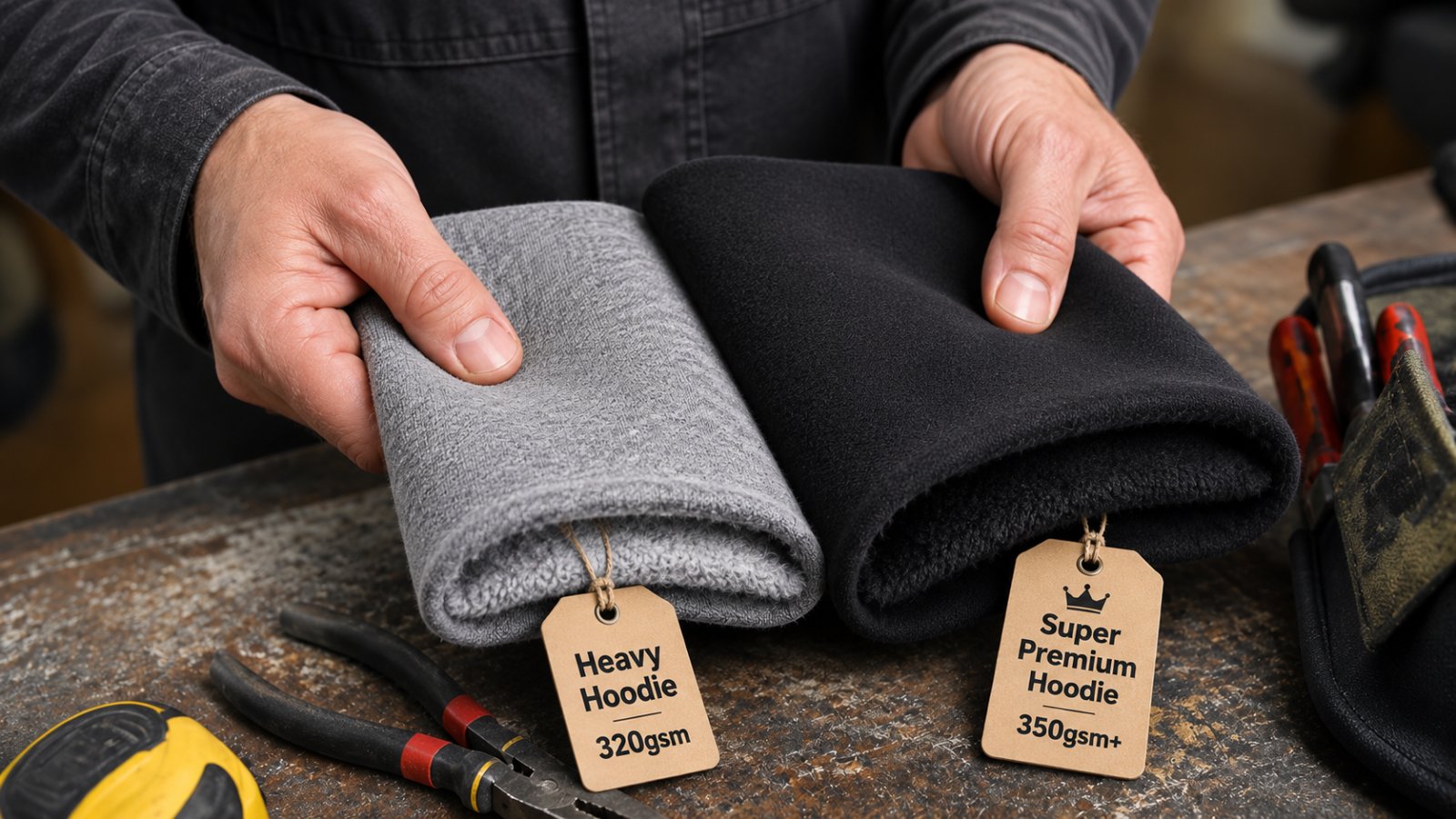
Fabric weight is measured in grams per square metre (gsm), and it is a useful number to check on a spec sheet.
What Fabric Weight in gsm Tells You
Heavier fabric generally resists wear better, but it also traps more heat. As a working guide:
- Under 160gsm: lightweight, best for indoor or summer use
- 160-200gsm: everyday tees and polo shirts
- 200-280gsm: mid-weight workwear, good all-round durability
- 280gsm and above: heavy-duty fabric for cold or abrasive conditions
Why Weave Matters as Much as Fibre
Two fabrics at the same weight can wear very differently.
- Twill has a diagonal pattern that packs fibres tightly. It resists abrasion and is common in trousers and jackets.
- Canvas is a heavy plain weave built for toughness. It suits bags and heavy jackets.
- Cotton drill is a strong twill weave, widely used in work trousers.
- Piqué has a textured surface that breathes well, which is why it suits polo shirts.
A tight weave with strong fibres beats a heavy but loose one every time.
The Best Fabric for Workwear Depends on the Task and Hazard
There is no single best fabric. There is only the right fabric for the job and the hazard in front of the wearer. Match the two and the garment earns its keep.
Role or environment |
Fabric direction |
Weight guide |
Hazard addressed |
|---|---|---|---|
Indoor warehouse and light trade |
Poly-cotton tees and polos |
180-220gsm |
Abrasion from shelving and repeated washing |
Site joinery and rough handling |
Cotton drill or twill |
240gsm and up |
Snagging, friction at knees and cuffs |
Warm kitchens and busy indoor roles |
Breathable piqué polos |
180-220gsm |
Heat build-up and moisture |
Outdoor and variable weather |
Softshell over a mid-weight base |
260-300gsm shell |
Wind, light rain, abrasion |
Welding and hot-work |
Tightly woven cotton or specialist flame-resistant fabric |
300gsm and up |
Sparks, spatter, heat |
Chemical handling |
Smooth, tightly woven fabric that sheds liquid |
200-260gsm |
Splash absorption and skin contact |
High-visibility roles |
Certified high-visibility fabric to the relevant standard |
Per standard |
Being seen in low light |
A few practical notes on each:
- Welding and hot-work. Sparks and spatter burn through loose, open weaves quickly. A tight cotton weave or a certified flame-resistant garment is the starting point. Never assume a heavy cotton drill is flame-resistant; check the certification label.
- Chemical handling. Smooth, tightly woven fabric gives splashes less chance to soak in. Where chemicals are a genuine risk, the garment must be specified for that hazard rather than chosen on weight alone.
- High-visibility work. High-visibility garments must meet the relevant British standard for the role (High visibility clothing). A tough fabric that is not certified does not satisfy a safety requirement.
- Cold and outdoor work. A softshell over a mid-weight base gives wind resistance and a layer of insulation without bulk. Check that the shell fabric is tightly woven so it resists abrasion from tools and equipment.
One caution: if a role carries a genuine safety requirement, such as flame resistance or high-visibility, check that the garment is certified for it. Do not assume a tough fabric meets a safety standard.
For professional front-of-house roles, a durable piqué polo gives a smart finish that holds up to repeated washing. You can view the embroidered Pro RTX piqué polo shirt as a practical example.

Fit, Mobility and Garment Construction
Durability is not only about fibre. A garment that restricts movement gets strained at the seams, and strain is where wear starts. Construction and fit decide whether a good fabric survives daily use.
Pro RTX RX500 Pro 2-Layer Softshell Jacket →
Check these build points before you buy:
- Reinforced stitching at stress points like shoulders and pockets
- Double-stitched seams on trousers and jackets
- Stretch content for roles with lots of bending or reaching
- A fit that allows layers without pulling across the back
A workwear jacket shows this well. The Pro RTX RX500 softshell jacket uses a 280gsm polyester softshell with a small amount of elastane, which adds give for active roles while keeping wind and shower resistance.

Watch out: buying a slim fit for a physical job is a false economy. The seams take the strain, and the garment fails long before the fabric does.
How to Care for Workwear So It Lasts
How to care for workwear matters as much as how you choose it. Washing and drying habits quietly decide whether a garment lasts two years or five. Fabric care is where most teams lose lifespan without noticing.
What Laundering Does to Fabric
Every wash cycle does three things: it removes soil, it abrades fibres, and it exposes them to heat and chemicals. The first is the goal; the other two are the cost. Understanding the cost is how you slow it down.
- Shrinkage. Cotton fibres relax and shorten when wetted and heated. A garment washed hot and tumble-dried hot can shrink noticeably in the first few cycles. A poly-cotton blend is less prone to shrinkage than pure cotton.
- Fading. Dyes are broken down by heat, detergent and UV light. Washing at lower temperatures and drying out of direct sun preserves colour for longer.
- Pilling. Short fibres work loose and ball up on the surface, usually where there is friction: underarms, cuffs, collars. Overloading the machine increases friction.
- Fibre breakdown. High heat makes fibres brittle. A garment dried on a high setting repeatedly will fail at flex points sooner than one air-dried.
A Care Routine That Protects Lifespan
Follow these habits:
- Wash at the lowest temperature that cleans the garment properly. For most workwear, 30°C is enough; reserve 40°C for genuinely soiled items.
- Turn garments inside out to protect the outer surface and any branding.
- Avoid overloading the machine, which increases friction and abrasion.
- Skip fabric softener, which can coat technical fabrics and reduce breathability.
- Air-dry where possible; high heat speeds up fibre breakdown.
- Treat stains early rather than washing repeatedly at high heat.
- Repair small faults early: a loose seam or a small tear is cheap to fix and expensive to ignore.
How Care Affects Service Life
Washing at lower temperatures and air-drying can help garments keep their shape and colour for longer. For teams, the practical move is to set a simple washing protocol and stick to it, because consistency across a uniform order is what protects the whole batch.
Good fabric care protects colour, shape and embroidery at the same time. It also keeps maintenance costs low over the life of the uniform.
A Practical Buying and Testing Checklist
A short checklist before you commit to a bulk order saves a lot of returns. Use it to test any sample before you scale up.
- Confirm the fibre mix and weight in gsm
- Check the weave suits the task and hazard
- Inspect stitching at seams, pockets and stress points
- Stretch and pull the fabric to test stretch resistance
- Rub a sample to gauge abrasion resistance
- Check shrink resistance and colourfastness notes
- Wash a sample twice and check for fading or pilling
- Confirm the fit allows ease of movement for the role
- Ask how the branding holds up after washing
- Compare cost against expected garment lifespan, not unit price
A cheap garment that fails in six months costs more than a better one that lasts three years. Price per wear is the number that matters.
Ordering Branded Workwear Built to Last
Once the fabric is right, the branding has to survive just as long. Embroidery is a sensible choice for uniforms, as the stitching sits in the fabric.
At Dprintclothing, we offer both printing and embroidery, with bulk discounts and fast delivery, working with brands including Fruit of the Loom, Russell and Gildan. Whether you need one item or a full team order, the process is built to stay simple.
If you are ordering jackets for a team, the embroidered Pro RTX RX500 softshell jacket shows how a durable base fabric and stitched branding work together.
Choosing durable workwear fabric is a decision you make once and live with for years. Get the fibre, weight, weave and construction right, and your team stays comfortable while your branding stays sharp.
Frequently Asked Questions
What is the best fabric for workwear?
There is no single best fabric; the right choice depends on the job. Heavy cotton drill suits site work where abrasion resistance matters, polyester performs better in wet or oily conditions, and a cotton polyester workwear blend balances comfort and durability for uniforms. Match the fabric weight and weave to the task, then check construction details like reinforced seams before ordering.
Is 80% cotton and 20% polyester a good blend for workwear?
Yes, an 80% cotton 20% polyester blend is a common and practical choice for workwear. The cotton content keeps the fabric breathable and comfortable against the skin, while the polyester adds strength and helps the garment resist shrinking and creasing. It suits general trade uniforms and embroidered polos, though very heavy abrasion may call for a higher polyester share or a heavier drill.
How do you tell whether workwear fabric is durable?
Check the fabric weight in gsm, the weave type and the construction. Heavier fabrics generally resist wear better, and tight twill or drill weaves handle abrasion well. Look for reinforced stitching at stress points, bar-tacked pockets and double-stitched seams. Ask for the fibre composition and test a sample by stretching and rubbing it before committing to a bulk order.
How should workwear be washed to help it last longer?
Wash at the lowest temperature that cleans the garment effectively, usually 30°C or 40°C, and turn garments inside out to protect printed or embroidered logos. Avoid overloading the machine and skip fabric softener, which can reduce breathability. Air-dry where possible, and only tumble-dry on low if needed. Follow the care label and treat stains promptly to extend garment lifespan.
Ready to kit out your team in workwear that holds up? Get started with Dprintclothing and order branded garments built to last, with embroidery and printing options, bulk discounts and fast delivery.