

Custom T-Shirts: A Buyer's Guide for Work and Teams
Last Updated: October 24, 2026
Quick Summary
Custom t-shirts in our range cost between £13.19 and £15.94 per unit before decoration, with fabric weight and fibre blend deciding how each garment holds shape and colour after repeated washing. Match heavier ring-spun cotton to daily workwear and lighter cotton to warm-weather teamwear.
- The spread between the cheapest and dearest garment is £2.75 per unit, or £275 on a run of 100.
- For trade teams, choose the B&C E190 at 185gsm or the Russell Classic T at 180gsm.
- Embroider simple, small, long-life logos; print complex, large or changing artwork.
- A left chest logo typically runs 8-10cm wide and sits 7-10cm below the shoulder seam.
- Wash at 30°C or lower inside out and skip the tumble dryer to protect decoration.
Table of Contents
- Custom T-Shirts Compared: Five Garments Side by Side
- Custom Work T-Shirts: Matching Fabric Weight to the Job
- Printing and Custom Embroidered T-Shirts: Which Decoration Suits Your Logo
- Logo Placement on T-Shirts: Getting Position and Size Right
- How to Order Custom Workwear Without Costly Mistakes
- What Custom T-Shirts Really Cost: Per-Unit Prices and Hidden Extras
- Sizing, Fit and Care: Keeping Personalised T-Shirts Looking Right
- Frequently Asked Questions
Custom T-Shirts Compared: Five Garments Side by Side
Choosing custom t shirts for a team, a trade business or an event usually comes down to one question: which garment will hold its shape and colour long enough to justify the spend? At Dprintclothing, we have supplied personalised apparel since 2015, and the answer almost always sits in the fabric specification rather than the price tag. Below, we compare five garments from our range on the numbers that actually matter, then work through decoration, placement, ordering and cost.
The comparison table
Garment |
Fabric |
Weight |
Price |
Best For |
|---|---|---|---|---|
Russell Classic T |
100% ring spun cotton |
180gsm |
£13.19 |
Premium feel, client-facing wear |
B&C Men's #E190 Tee |
100% pre-shrunk ring-spun cotton |
185gsm |
£14.29 |
Workwear that keeps its shape |
Printer Prime T-shirt |
60% organic cotton, 40% recycled polyester |
180gsm |
£15.94 |
Sustainability-led orders |
Fruit Of The Loom Valueweight |
100% cotton |
165gsm |
£13.74 |
High-volume promotional runs |
Gildan Softstyle Adult |
100% ring spun cotton |
150gsm |
£13.63 |
Lightweight summer teamwear |
The spread between the cheapest and dearest garment here is £2.75 per unit. On a run of 100, that is £275, which is often less than the cost of reprinting a batch that shrank or faded. Weight and fibre blend decide how a custom t-shirt behaves after twenty washes, so read those columns before the price column.
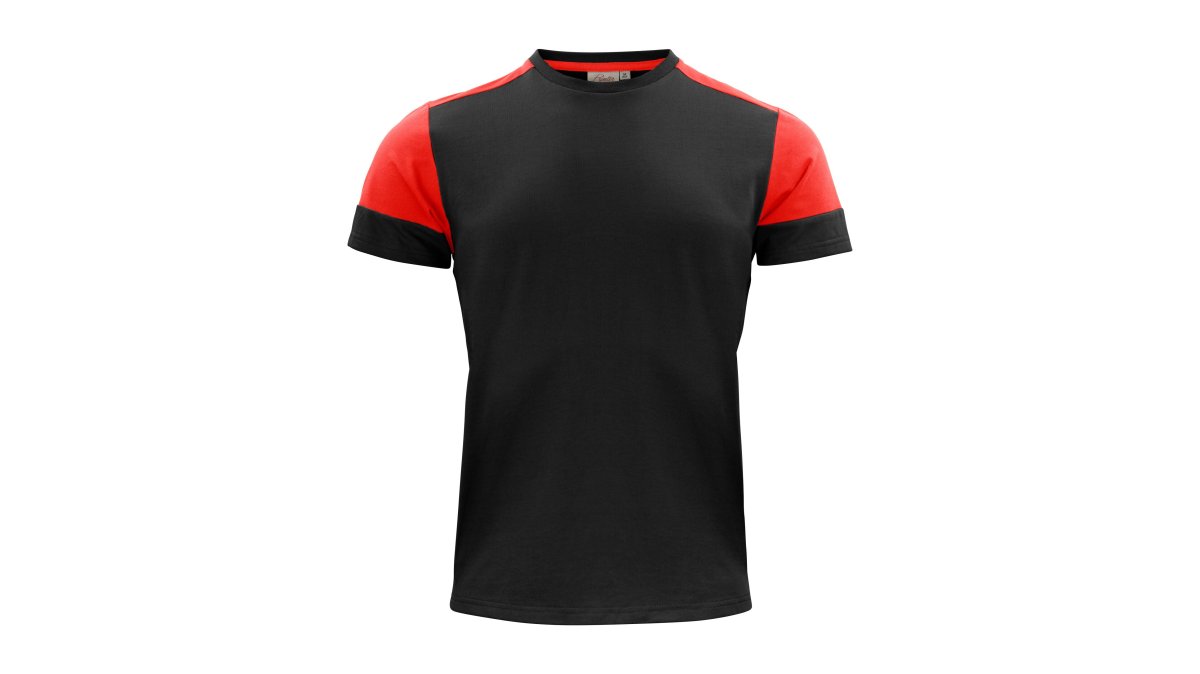
Custom Work T-Shirts: Matching Fabric Weight to the Job
Fabric weight is the single best predictor of whether custom work T-shirts survive a real working week. Heavier cotton holds shape and resists transparency; lighter cotton feels cooler but shows wear faster.

For trade teams, we would steer you towards the B&C #E190 at 185gsm or the Russell Classic T at 180gsm.
A common mistake is buying the cheapest garment for a uniform that gets worn five days a week. The saving disappears the moment you replace half the batch inside a year. If you want a collar-based alternative for supervisors, the Printer Prime Polo Shirt is worth a look alongside the tees.
Printing and Custom Embroidered T-Shirts: Which Decoration Suits Your Logo
Decoration choice should follow the artwork, not the other way round. Custom embroidered T-shirts suit compact logos, crests and text up to roughly the size of a palm; printed decoration handles large graphics, gradients and photographic artwork that stitching cannot reproduce.
Embroidery gives a raised, textured finish that reads as premium on polos, jackets and heavier tees. It also survives industrial washing better than most print finishes because the thread sits in the fabric rather than on top of it.
Printing wins on flexibility. Full-colour logos, sponsor blocks and event graphics all reproduce cleanly.
Use the table below as a starting point for matching decoration to the job:
Consideration |
Embroidery |
Printing |
|---|---|---|
Best artwork |
Simple logos, crests, wordmarks |
Full-colour, photos |
Minimum detail |
Text roughly 5mm and above |
Fine detail reproduces well |
Durability |
Very high, survives industrial washing |
High |
Cost behaviour |
Driven by stitch count |
Driven by quantity |
Feel |
Raised and textured |
|
Best garments |
Polos, jackets, heavier tees |
Light and heavy tees alike |
If your logo is embroidered, you can browse the custom embroidered Ultra Cotton long sleeve t-shirt to see how stitching sits on a heavier garment. For printed orders, the Russell Classic T and B&C #E190 both take decoration well because their ring-spun surface is smooth and tight.

Logo Placement on T-Shirts: Getting Position and Size Right
Logo placement on T-shirts follows a small set of conventions, and getting them right makes a modest budget look professional. The standard left chest position sits roughly 7-10cm below the shoulder seam, with the logo centred over the wearer's left chest.
Size matters more than most buyers expect. A left chest logo typically runs 8-10cm wide. A full front print can go to A4 or beyond, and a back print often suits A3. Oversized chest logos look promotional rather than uniform, which is rarely what a trade business wants on client-facing staff.
Placement rules worth writing into your order:
- Left chest for corporate identity, right chest for sponsor or accreditation marks
- Back print for event names, slogans or sponsor rows
- Sleeve prints for small logos, kept under about 6cm
- Never straddle a seam with embroidery; it puckers
How to Order Custom Workwear Without Costly Mistakes
Ordering custom workwear goes wrong in predictable ways, and nearly all of them are avoidable at the artwork stage. The most common is submitting a low-resolution logo, which forces a redraw and delays the whole run.
Work through this checklist before you approve anything:
- Artwork supplied as vector (AI, EPS, SVG) or at 300dpi minimum
- Exact colour references agreed, ideally Pantone for embroidery thread
- Sizing split confirmed against real measurements, not guesses
- Garment, colour and decoration method locked in writing
- Delivery date confirmed against your event or start date
- One sample approved before the full run is released
If you are new to this, our guide on choosing the right custom clothing walks through the wider decision from garment type to order quantity. A common mistake is ordering exactly the headcount with no spares; add a couple of extra units in the middle sizes for replacements and new starters.
What Custom T-Shirts Really Cost: Per-Unit Prices and Hidden Extras
Custom t-shirts cost between £13.19 and £15.94 per unit in our range before decoration, and the extras are where budgets drift.
Most competitors stop at the garment price. The useful number is the landed cost per shirt, garment, decoration, setup and delivery added together and divided by the quantity you actually need.
A single printed tee carries a setup cost that a run of 100 spreads thinly.
Cost Line |
What It Covers |
How to Control It |
|---|---|---|
Garment |
Base t-shirt at listed price |
Choose weight to match lifespan |
Decoration |
Print or embroidery per unit |
Consolidate to fewer logo positions |
Setup |
Preparing print or embroidery files |
Reuse artwork across repeat orders |
Delivery |
Standard or express shipping |
Order earlier to avoid express rates |
Worked example: take the Fruit Of The Loom Valueweight at £13.74 for a 100-unit promotional run.
Three levers move the landed cost most:
- Quantity, setup and delivery dilute as volume rises, so quote at your real number, not a sample.
- Logo positions, each additional position adds decoration cost per unit; a left chest plus a back print is two charges, not one.
- Timing, standard delivery is cheaper than express, and express is the line most often added late when a date was missed.
Bulk discounts apply on larger runs, so it is worth asking for a quote at your real quantity rather than a trial batch.
Sizing, Fit and Care: Keeping Personalised T-Shirts Looking Right
Personalised t-shirts stay looking right when the garment is washed inside out, at low temperature, and never tumble dried on high heat. Heat is what breaks down print adhesives and shrinks cotton.
Ring spun and pre-shrunk cottons, like the B&C #E190, hold their size better through repeated washing.
Care rules that protect decoration:
- Wash at 30°C or lower, inside out
- Avoid fabric conditioner on printed areas; it dulls the finish
- Do not iron directly over embroidery; press from the reverse
- Skip the tumble dryer, or use the lowest setting
If your order spans tees and heavier layers, the custom Gildan hoodies follow the same care logic, and buying both from one supplier keeps colour matching consistent across the kit.
Frequently Asked Questions
How do I choose custom T-shirts for work?
Start with the job the shirt has to do. For client-facing uniforms, pick a mid-to-heavyweight cotton such as the Russell Classic T at 180gsm or the B&C #E190 at 185gsm, because they hold shape through repeated washing. For indoor or promotional use, a lighter 150gsm Gildan Softstyle keeps costs down and feels cooler. Then confirm decoration: embroidery for chest logos on workwear, print for large back graphics. Order one sample before committing to a full run so you can check fit, colour and logo position in person.
What fabric is best for custom work T-shirts?
100% ring spun cotton is the default for workwear because it takes print and embroidery cleanly and feels soft against the skin. Heavier weights, around 180gsm to 185gsm, resist wear better than 150gsm styles and are less likely to go thin at the collar. If sustainability matters to your business, the Printer Prime T-shirt uses 60% organic cotton and 40% recycled polyester at 180gsm, which suits teams that publish environmental credentials. Avoid very light fabrics for daily trade use; they show wear faster.
Are embroidered T-shirts suitable for workwear?
Yes, and for chest logos they are often the better choice. Embroidery gives a raised, textured finish that reads as professional on client-facing uniforms and holds up to frequent laundering without cracking or fading. It suits small to medium logos placed on the left chest, and works well on heavier cotton such as the 185gsm B&C #E190. Large back graphics are usually better printed, since dense embroidery over a wide area adds weight and stiffness. Many workwear orders combine both.
How should a logo be positioned on a custom T-shirt?
For a standard left-chest logo, position it roughly 7cm to 9cm below the shoulder seam and centre it over the chest, keeping the logo width to around 8cm to 10cm. Centre back prints usually sit 5cm to 8cm below the collar. Keep a consistent position across every garment in an order, because mismatched placement is the most visible quality fault on teamwear. Ask for a digital proof showing placement on the actual garment style before production starts.
Can I order custom T-shirts in different sizes and styles?
Yes. A single order can mix sizes across the same garment, which is normal for teams and workplaces where you are fitting a range of body types. You can also mix garment styles in one order, for example a heavier Russell Classic T for site staff and a lighter Gildan Softstyle for event volunteers. Send a size list with your order rather than guessing quantities, and check the supplier's size chart against actual chest measurements, since sizing varies between brands.
Getting branded clothing right is less about picking the cheapest garment and more about matching fabric, decoration and placement to how the kit will actually be worn. Dprintclothing handles both printing and embroidery in-house, works with Russell, Gildan, B&C and Fruit of the Loom, and offers bulk discounts on larger runs with a free online designer for artwork. Get started with Dprintclothing and build a workwear order that still looks sharp a year from now.

