Cheap vs Premium Bulk Custom T-Shirts for UK Teams
Last Updated: November 17, 2026
Quick Summary
You can buy cheap custom t-shirts in bulk in the UK from around £13.63 to £14.29 per shirt, with one print included on the AWDis 150. Unit prices fall as quantity rises because fixed setup costs are spread across more garments. Always compare fully landed cost per shirt, including delivery, VAT and artwork fees.
- Fabric weight is the biggest spec decision: 150gsm suits events, 185gsm holds shape through repeated washing.
- A worked example shows landed cost per shirt dropping from £13.80 at 25 units to £12.45 at 100.
- Supply vector artwork with fonts converted to outlines and raster images at 300dpi at final print size.
- Production starts once you approve the artwork proof, so build in a buffer of at least a week before your event.
- The Fruit of the Loom Valueweight at 165gsm and £13.74 balances price and durability for value-focused orders.
Table of Contents
- Bulk Custom T-Shirts at a Glance: Price and Spec Comparison
- What Drives the Price of Cheap Custom T-Shirts in Bulk
- Custom T-Shirt Minimum Order Quantity: What to Expect
- T-Shirt Artwork Requirements Before You Order
- Bulk T-Shirt Turnaround Time and Delivery Planning
- Working Out Your Fully Landed Cost Per Finished Shirt
- Choosing the Right Bulk Custom T-Shirts for Your Order
- Frequently Asked Questions
Bulk Custom T-Shirts at a Glance: Price and Spec Comparison
Shopping for cheap custom t-shirts in bulk in the UK usually starts with a simple question: what does each shirt actually cost once printing is included? Here are five options from our range, all priced per shirt, with one print included where stated.
T-Shirt |
Fabric |
Weight |
Price Per Shirt |
Best For |
|---|---|---|---|---|
Gildan Softstyle Adult |
100% ring-spun cotton |
150gsm |
£13.63 |
Lightweight summer events |
Fruit of the Loom Valueweight |
100% cotton |
165gsm |
£13.74 |
Everyday value orders |
Gildan Heavy Cotton |
100% cotton |
185gsm |
£13.74 |
Hard-wearing workwear |
AWDis 150 |
PurePrint fabric |
150gsm |
£13.74 |
One A3 print included |
B&C Men's #E190 |
Pre-shrunk ring-spun cotton |
185gsm |
£14.29 |
Client-facing uniforms |
Weight
What Each Price Actually Includes
Each figure above is a per-garment price, and the AWDis 150 is the clearest example of what "included" means: one print up to A3 size comes with the shirt. For the other styles, confirm print placement and size when you request a quote, because a small left-chest logo and a full back print are different jobs. If you want a deeper breakdown of how quotes are built, our guide to what bulk workwear printing really costs walks through the components line by line.
What Drives the Price of Cheap Custom T-Shirts in Bulk
Four things move the unit price more than anything else: fabric weight, order quantity, print size and print placement. A 150gsm shirt costs less to make than a 185gsm shirt, and that difference shows up in what you pay. Quantity matters just as much, since larger runs spread setup work across more garments. Print size follows the same logic: a small chest logo uses less material and press time than an A3 back print.
Fabric Weight and Why It Changes the Unit Price
Fabric weight is the single biggest spec decision in a bulk order, measured in grams per square metre. Lighter weights around 150gsm suit warm-weather events and one-off promotions, while 185gsm cotton holds shape through repeated washing and daily wear on site. Heavier fabric costs more per shirt, but it usually lasts longer, which brings the cost per wear down. Our fabric guide for custom work shirts compares cotton, polyester and polycotton by weight and job so you can match the cloth to the work.
Custom T-Shirt Minimum Order Quantity: What to Expect
A custom T-shirt minimum order quantity is the smallest number of garments a printer will accept for a given job, and it varies by decoration method, design and garment. Small runs are possible, but the per-shirt price falls as quantity rises because fixed setup work, artwork preparation, proofing, press setup and packing, is shared across more items. The useful question is not 'what is the minimum?' but 'where does the price stop falling?'
Why the Price Steps Down
Setup costs are fixed per job, not per shirt, so they are spread across more garments as quantity rises. Material and garment costs, by contrast, scale roughly linearly.
A Worked Break-Even Example
Suppose a quote shows a fixed artwork and setup charge of £30 per job, a garment-and-print cost of £12.00 per shirt, and delivery of £15 per order. The landed cost per shirt at three quantities works out as:
Quantity |
Setup per shirt |
Garment and print per shirt |
Delivery per shirt |
Landed cost per shirt (ex VAT) |
|---|---|---|---|---|
25 |
£1.20 |
£12.00 |
£0.60 |
£13.80 |
50 |
£0.60 |
£12.00 |
£0.30 |
£12.90 |
100 |
£0.30 |
£12.00 |
£0.15 |
£12.45 |
Choosing Your Quantity
Order to the number you will actually use, not to the cheapest per-shirt figure. Surplus stock ties up cash and may never be worn. If you are unsure, order a small run first, confirm the fit and print quality, then place the bulk order, the extra setup charge on the second job is usually smaller than the cost of 50 unworn shirts.
Ask for a quote at two or three quantities, for example 25, 50 and 100 shirts, and request the setup, delivery and VAT treatment in writing so the comparison is like for like. You can view bulk ordering and discount options before you commit to a number.
T-Shirt Artwork Requirements Before You Order
Clean artwork is the difference between a sharp print and a rejected proof, and it is also the difference between a quote that holds and one that grows. Artwork problems are one of the most common sources of hidden charges, because redraws, extra proofs and reprints all cost money and time. Getting the file right before you order is the cheapest quality control available.
What to Supply
- Vector files where possible: SVG, EPS or PDF, with fonts converted to outlines so text cannot reflow on another machine.
- Raster images at final size: at least 300dpi at the print dimensions, not at screen size. A logo pulled from a website often looks fine on a monitor and prints soft at A3.
- Colour references: Pantone references if brand consistency matters, and a note on whether the design is one colour or full colour.
- Exact dimensions and placement: state the print width and height in millimetres and where it sits (for example, centred on the chest, 70mm below the collar). A small left-chest logo and a full back print are different jobs with different costs.
Artwork Problems That Add Cost
Common artwork issues can lead to unexpected charges:
- Low-resolution or web-sourced logos that need redrawing before they can be printed.
- Missing fonts that have to be substituted or traced.
- Wrong colour mode that shifts brand colours on press.
- Undersized artwork that has to be recreated at print size.
- Late changes after proof approval, which can trigger a reprint at your cost.
Each of these can appear as a setup, redraw or reprint charge on the invoice. None of them is inevitable if the file is checked first.
The Quote Checklist
Before you approve a quote, confirm in writing:
- Is artwork preparation or redraw included, or charged separately?
- Is a digital proof included, and how many revisions are free?
- What is the charge for changes after proof approval?
- Are samples available, and are they charged?
- Is there a rush or priority fee?
- Is delivery included, and is VAT shown?
- What is the reprint policy if the print is faulty?
A supplier who answers these clearly is easier to compare against another, because you are comparing totals rather than headline rates. If you want a deeper breakdown of how quotes are built, our guide to what bulk workwear printing really costs walks through the components line by line.
Watch out: approving a proof without checking the print dimensions in millimetres is the most common way a good design arrives at the wrong size, and a resize after approval is usually chargeable.
Bulk T-Shirt Turnaround Time and Delivery Planning
Bulk T-shirt turnaround time covers two stages: production and delivery. Production starts once you approve the artwork proof, so a slow approval is the most common cause of a missed deadline. Build in a buffer of at least a week before any fixed event date, and confirm dispatch times in writing rather than relying on a general promise. If you are working to a hard deadline, check delivery and dispatch information first so the schedule matches your event.
Working Out Your Fully Landed Cost Per Finished Shirt
The number on a quote is rarely the number you end up paying per shirt, because delivery, VAT and artwork setup can sit outside it. Work out your fully landed cost before you compare suppliers, and check whether each quote is price including VAT or price excluding VAT. Ask whether each quote includes the garment, delivery, and VAT.
- Garment price per shirt from the quote
- Print cost if charged separately
- Artwork or setup fee divided by order quantity
- Delivery charge divided by order quantity
- VAT added if the quote excludes it
- Total divided by number of shirts = landed cost
Choosing the Right Bulk Custom T-Shirts for Your Order
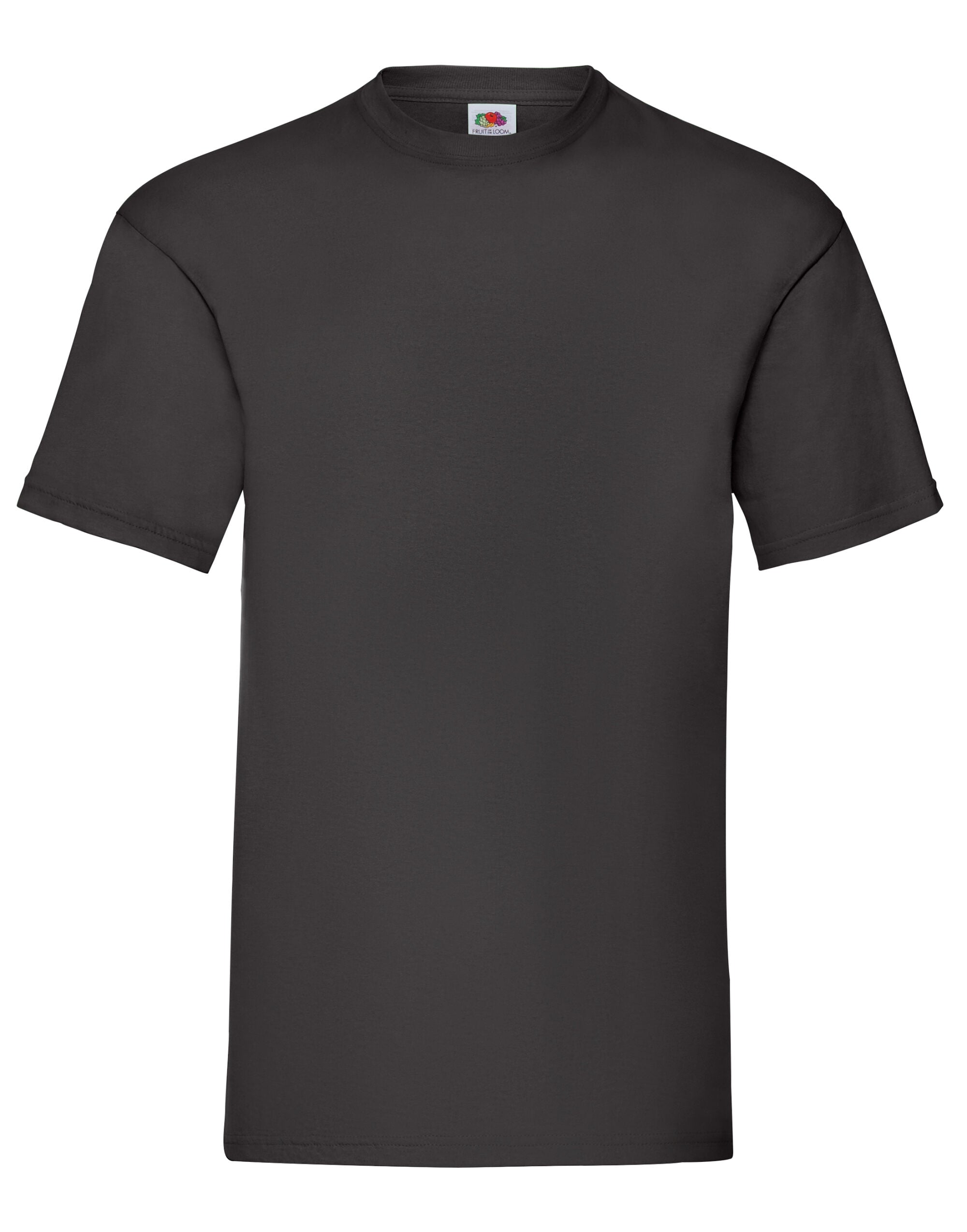
Match the shirt to the job rather than the lowest headline price. For trade teams who wear the same shirt five days a week, a 185gsm cotton style such as the B&C Men's #E190 or Gildan Heavy Cotton holds up better than a lighter tee. For a one-day event or giveaway, the Gildan Softstyle at 150gsm keeps costs down without looking thin. A solid starting point for most value-focused bulk orders is the Fruit of the Loom Men's Valueweight T-Shirt, a 165gsm 100% cotton style at £13.74 that balances price and durability.
Best for: teams wanting a durable everyday shirt at a fair per-unit price. Skip if: you need maximum lightweight breathability for hot outdoor events.
Ordering in volume should not mean guessing at prices or chasing quotes for days. Dprintclothing has specialised in custom apparel since 2015, offering both printing and embroidery, bulk discounts, and fast delivery on garments from names like Fruit of the Loom, Russell and Gildan. Send us your artwork and quantity and we will give you a straight per-shirt figure. Get started with Dprintclothing and kit out your team without the invoice surprises.
Frequently Asked Questions
What should I compare when ordering custom T-shirts in bulk?
Compare the total landed cost per shirt, not the headline price. Check whether the garment is included, what fabric weight you get, how large the included print area is, whether VAT is shown, and what delivery adds. A shirt quoted at a lower unit price can cost more once a second print position or delivery is added. Ask for a written quote covering garment, print, VAT and delivery in one figure.
How many custom T-shirts do I need to order?
Order for the number of wearers plus a small buffer for sizing swaps and replacements. For a team or staff order, count actual headcount, then add roughly 5 to 10 per cent. Larger runs lower the unit price because setup and print costs spread across more garments, so if you expect to reorder within a few months, ordering the larger quantity once usually works out cheaper per shirt.
What artwork file should I provide for bulk custom T-shirts?
Supply vector files such as AI, EPS or SVG where possible, or a high-resolution PNG at 300 DPI for raster artwork. Keep text as outlines so fonts do not shift, and use a transparent background. Artwork should be sized to the print area you want, for example A4 or A3, at the correct proportions. Low-resolution or screenshot files often print soft at the edges, so check the file before sending.
Which T-shirt fabric is best for a bulk order?
It depends on use. For workwear and everyday staff uniforms, a heavier 185gsm cotton such as the Gildan Heavy Cotton is a durable option. For event giveaways and warm-weather wear, a lighter 150gsm ring-spun cotton such as the Gildan Softstyle is a good choice. Match the weight to how often the shirt will be worn and washed.
Can I order different sizes in one bulk custom T-shirts order?
Yes. Bulk orders normally let you mix sizes within the same design and garment, so you can order small through to extra large in one run. Send a size breakdown with your order rather than a single total, and check the supplier's size chart against actual chest measurements, since sizing varies between brands. Mixing sizes does not usually change the unit price.