

Best Alternative to Clothes2Order for Embroidery
Last Updated: October 25, 2026
Quick Summary
The best alternative to Clothes2Order for embroidery is a supplier that holds stitch quality, confirmed lead times, clear small-run pricing and proof approval before stitching starts. At Dprintclothing we have supplied embroidered workwear since 2015, and buyers switch when a supplier stops being predictable, not when it stops being inexpensive.
- Four factors decide a switch: stitch quality, turnaround, minimum order quantity and proof approval.
- Ask for the minimum order quantity in writing before you design anything.
- Approve a digital proof, then a physical stitch-out sample, before the full run.
- Wash a sample twice at the care label temperature before approving production.
- Start with one garment type, one logo placement and a sample.
Table of Contents
- Why Buyers Switch Embroidery Suppliers
- Embroidered Workwear Suppliers Compared at a Glance
- Custom Embroidered Clothing: Five Garments That Hold a Stitch
- Small Quantity Embroidered Clothing Without the Bulk Penalty
- Logo Embroidery on Workwear: Files, Proofs and Placement
- Quality Checks That Separate Professional Finish From Average
- Sourcing Ethically Without Paying Over the Odds
- Ordering Your First Embroidered Workwear Range
- Frequently Asked Questions
Why Buyers Switch Embroidery Suppliers
Most buyers don't leave an embroidery supplier over one bad order. They leave because the fourth small disappointment lands on top of the first three.
If you are weighing up the best alternative to Clothes2Order for embroidery, the real question is not who charges least per stitch. At Dprintclothing we have supplied embroidered workwear since 2015, and the pattern is consistent: buyers switch when a supplier stops being predictable, not when it stops being inexpensive.
The Four Things That Decide a Switch
Four factors separate suppliers you keep from suppliers you replace:
- Stitch quality that survives washing. Thread density, tension and backing matter more than the sample photo suggests.
- Turnaround you can plan around. Lead times that hold, not lead times that get promised.
- A minimum order quantity that fits the job. Small quantity embroidered clothing should not be penalised.
Get all four right and price becomes a secondary conversation.
Embroidered Workwear Suppliers Compared at a Glance
The table below summarises what to weigh when comparing embroidered workwear suppliers. Use it as a scoring sheet rather than a shopping list.
Criterion |
What Good Looks Like |
What to Watch For |
|---|---|---|
Stitch quality |
Dense, even coverage; clean edges on small text |
Loose threads, puckered fabric, distorted lettering |
Turnaround time |
Confirmed lead time in writing |
Vague "usually within" promises |
Minimum order quantity |
Clear small-run pricing |
Hidden setup fees on low volumes |
Garment range |
Named brands with stated weights |
Unbranded stock with no spec sheet |
Proof approval |
Digital proof before production |
"Trust us" on placement |
File handling |
Vector artwork accepted, digitising offered |
Charging for redraws you didn't need |
Custom Embroidered Clothing: Five Garments That Hold a Stitch
Not every garment embroiders well. Tight weaves and unstable knits distort under dense stitching, which is why fabric choice is the first quality decision you make. These five hold a stitch reliably.
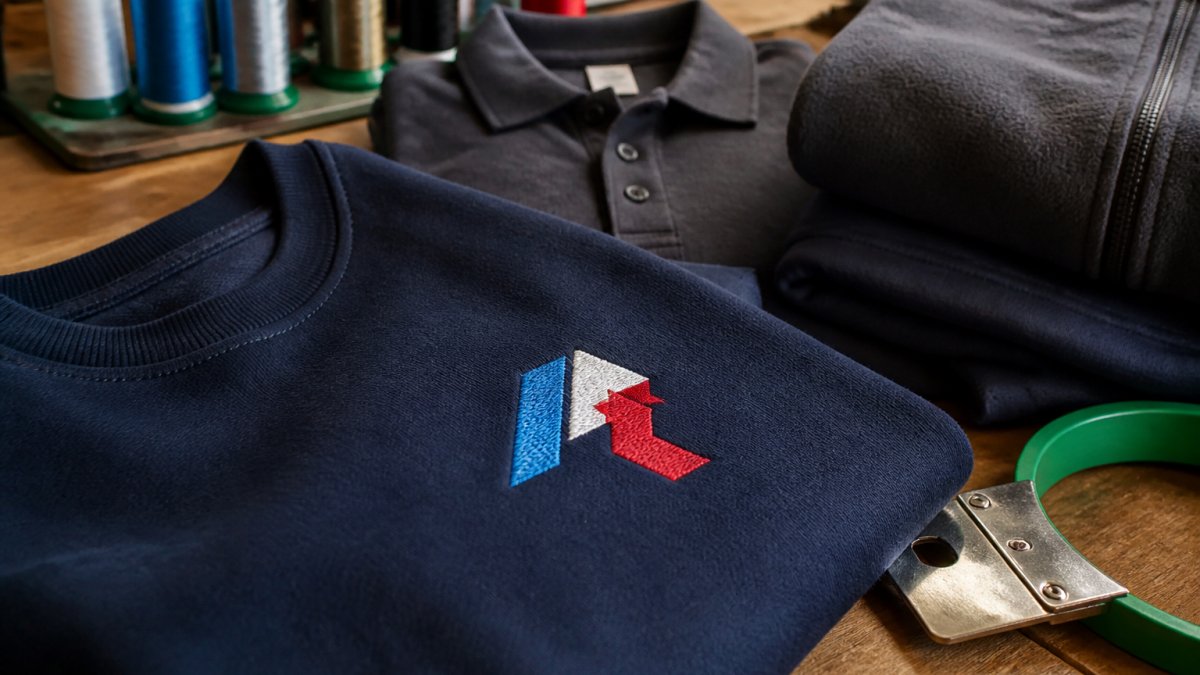
RX301 Pro Sweatshirt and RX350 Pro Hoodie
The RX301 Pro RTX Pro Sweatshirt (£16.49) is a 300gsm 55% polyester, 45% cotton blend with ribbed cuffs, hem and crew neck plus a taped neckline. That weight gives embroidery a stable surface, which is why it suits logos, staff names and trade workwear. The RX350 Pro Hoodie (£24.19) uses the same 300gsm blend in a modern fit, aimed at team uniforms and promotional apparel.
RX101 Polo, RX402 Fleece and Thor III Fleece
The RX101 Pro Piqué Polo (£14.29) is a 220gsm 50/50 cotton-polyester classic fit, smart enough for client-facing uniforms. The RX402 Pro Fleece (£23.64) is a 300gsm anti-pill polyester that insulates without losing shape. The Thor III Men's Interactive Fleece (£23.64) is a 280gsm Regatta option for outdoor teams.
Small Quantity Embroidered Clothing Without the Bulk Penalty
Small quantity embroidered clothing is where most suppliers get awkward. A five-person team ordering jackets often hits a minimum order quantity, a setup fee, or a quote that quietly doubles per unit.
Here is how to keep a small run sensible:
- Ask for the minimum order quantity in writing before you design anything.
- Confirm whether a setup fee applies once per order or once per logo.
- Check whether digitising is charged separately from production.
Watch out: a low headline unit price can hide a per-order setup fee that makes a ten-piece run far more expensive than the quote suggested. Ask for the total, not the unit rate.
Logo Embroidery on Workwear: Files, Proofs and Placement
Logo embroidery on workwear lives or dies on the artwork you send. Embroidery is not printing: a machine translates your design into stitches, so the file needs to be clean, scalable and colour-separated.
What Your Artwork Needs Before Digitizing
Send vector artwork wherever possible. A high-resolution raster file can be redrawn, but expect a charge and a delay. Before digitising, confirm:
- Vector format, or a clean high-resolution image at minimum
- Pantone or thread colour references, not screen colours
- Exact dimensions for the logo at final size
The Stitch File Formats That Actually Matter
Digitising is the process of converting artwork into a stitch file the embroidery machines can read. The two formats you will encounter most are DST and PES.
A good digitised file is not simply a traced outline. The digitiser sets stitch type, stitch density, underlay, pull compensation and the stitch sequence. These are the settings that decide whether small text stays legible at final size.
A Proof Approval Workflow That Removes the Risk
Approving a proof is not a formality. Work through it in this order:
- Digital proof first. Ask for a visual of the logo at final size on the garment, with thread colour references shown. Check spelling, spacing and placement against your brand guidelines.
- Stitch-out sample second. A digital proof cannot show how thread behaves on the fabric. Ask for a sewn sample on the actual garment you intend to order, not a generic swatch.
- Check the sample against the criteria below before you release the full run.
Approve the proof before production starts; a stitch-out sample is the only reliable check on small text.
Embroidered RX301 Pro RTX Pro Sweatshirt →
Placement: The Detail Buyers Get Wrong
Placement is specified in millimetres from a fixed reference point, usually the shoulder seam or centre front. For a left breast logo, you can order the breast-size logo digitising service directly. Ask the supplier to confirm the reference point and the finished position in writing. If you are planning a back placement, you can order the back-size logo digitising service.
Quality Checks That Separate Professional Finish From Average
Professional finish comes down to four measurable things: stitch density, thread tension, backing stability and edge definition. Ask any supplier how they control these before you order, and listen for whether the answer is specific or a reassurance.
What Each Quality Factor Actually Means
- Stitch density is the number of stitches per unit area. Too low and the garment shows through; too high and the fabric puckers and the thread can break. A supplier should be able to tell you how density is set for different fabric weights.
- Thread tension controls whether stitches sit flat or pull the fabric into a ridge. Balanced tension looks even on both sides of the stitch; poor tension shows as loops or a tight, puckered edge.
- Backing stability refers to the stabiliser used behind the stitching. Cut-away backing is trimmed after stitching and suits fabrics that will be washed repeatedly; tear-away is quicker but can loosen over time. Ask which is used on the garments you are ordering.
A Sample Approval Checklist
Judge a sample against these before you approve a full run:
- Small text is legible at final size, not blurred into a block
- No puckering around the stitch edge
- Thread colours match your brand reference
Post-Wash Durability: The Test Most Buyers Skip
Post-wash durability is an important test. Wash a sample twice at the care label temperature before you approve a full run, then check:
- Whether the logo has distorted, shrunk or puckered
- Whether thread colour has bled or faded
- Whether any stitches have loosened or pulled
If the logo holds shape and colour after two washes, the stitching is sound. If it does not, you have found the problem on a sample rather than on a fifty-piece order.
Questions That Reveal a Supplier's Real Process
Ask these before you commit, and note whether the answers are specific:
- Which backing do you use on this garment, and why?
- What is the minimum legible text height you can hold?
- Do you provide a stitch-out sample before a full run?
A supplier who answers these in specifics is controlling quality. A supplier who answers in reassurances is hoping you will not ask again.
Sourcing Ethically Without Paying Over the Odds
Ethical sourcing does not require a premium supplier. It requires asking specific questions and accepting specific answers.
Ask where the garments are made, whether the supplier works with named brands with published supply chain information, and whether they can confirm fabric composition and weight. For context on responsible sourcing expectations, the Ethical Trading Initiative base code sets out labour standards many apparel buyers reference.
Fabric durability ties directly to ethics too: a 300gsm garment that lasts three years is a better use of resources than a thin one replaced annually.
Ordering Your First Embroidered Workwear Range
Start with one garment type, one logo placement and a sample. Once you have approved the stitch quality, scale to the full range with confirmed lead times and a written minimum order quantity.
A sensible first order looks like this:
- Choose two garments from the range above.
- Send vector artwork and thread colour references.
- Approve the digital proof, then a physical sample.
- Confirm lead time and total cost in writing.
- Place the full run and check the first delivery against the sample.
If you are ready to move from comparison to production, you can view the RX301 Pro sweatshirt or order the RX350 Pro hoodie directly, and the Thor III fleece can be customised with your own embroidery.


Frequently Asked Questions
What is the best alternative to Clothes2Order for embroidery?
The best embroidery alternative depends on what you need most: low minimums, fast lead times, or dense stitching that survives industrial washing. Compare suppliers on stitch density, digitizing setup fees, garment weight and proof approval before you commit. A 300gsm poly-cotton sweatshirt with a proper digitized file will outlast a cheap 280gsm option, so ask for a sample stitch-out on your own logo first.
Can I order embroidered clothing in small quantities?
Yes. Small quantity embroidered clothing is widely available, and many suppliers now price single garments without a bulk penalty. The main cost driver is the one-off digitizing setup fee, which applies whether you order one item or one hundred. Once that file exists, adding extra garments is cheap. Order one sample first to check thread colours and logo placement, then scale up once you are happy with the proof.
How do I prepare a logo for clothing embroidery?
Supply vector artwork such as an AI, EPS or SVG file, or a high-resolution PNG at 300dpi minimum. Embroidery software converts this into a stitch file, a process called digitizing. If you only have a low-resolution image, a good supplier will redraw it, but expect a setup fee and a longer proof turnaround.
How long does embroidered workwear take to produce?
Typical turnaround time runs 5 to 10 working days from proof approval, depending on order size and garment stock. Digitizing adds 1 to 2 days if you need a new stitch file. Bulk orders of 50 or more jackets can take longer, so confirm lead times in writing before you order for an event. Ask whether the supplier holds stock of your chosen garment or orders it in, because that is where most delays start.
Is embroidery suitable for business uniforms?
Embroidery is the standard choice for client-facing uniforms because stitched logos hold colour and shape through repeated industrial washing. On workwear, place the logo on the left breast at roughly 80mm to 100mm wide, and add staff names on the opposite side if needed. Choose a garment with reinforced stitching and a smooth surface, such as a 220gsm piqué polo, for the cleanest professional finish.
The gap between an average embroidered uniform and a professional one is rarely the price. It is the proof, the stitch density and the lead time you can actually rely on. Dprintclothing has specialised in custom apparel since 2015, offering both embroidery and printing, bulk discounts, and fast delivery on garments from Fruit of the Loom, Russell and Gildan. Get started with Dprintclothing and build a workwear range that still looks right after a year of washing.

